Vision Care Expenses Claimable Through a Canadian HSA
Vision expenses need a prescription to qualify through your HSA.
A Health Spending Account in Canada is a legal arrangement, not a flexible perk an employer invents on its own Health Spending Account (HSA) Canada Guide 2026 | CRA Rules & Eligibl…. It's technically a Private Health Services Plan, defined under the Income Tax Act. That legal status is what makes the whole thing work, and it's also what limits it.
The list of what an HSA can reimburse isn't set by the plan administrator. It mirrors the CRA's Medical Expense Tax Credit list, the same list, the same legislation, the same test applied to both. Missing that threshold puts the plan's status at risk, and reimbursements stop being tax-free as a result.
That single rule causes vision care to appear as such a wide category on most HSA eligible-expense lists. Vision sits squarely inside the METC catalogue, so the eligible vision category ends up broader than a lot of people expect walking in. Some plans call themselves an HCSA, a Cost Plus plan, or a Health Care Expense Account. The name on the paperwork changes nothing about the underlying CRA rules, they apply the same way no matter what the account is branded.
What actually separates an eligible vision expense from an ineligible one comes down to medical purpose. Genuine treatment or correction qualifies. Lifestyle spending, even health-adjacent lifestyle spending, does not. That distinction runs through every category below.
The prescription requirement: the single rule that determines what vision expenses qualify
Almost every vision claim question boils down to one thing: did a licensed optometrist or ophthalmologist prescribe it? Eyeglasses, contact lenses, sunglasses, sports goggles, specialty lenses, all of it turns on that single fact. A prescription makes the item claimable. No prescription, no claim, regardless of how medically reasonable the purchase might feel.
Eye exams work a little differently, and the two tests should be kept separate. Exams and surgical procedures qualify because a licensed professional performed them. That's a related idea but a distinct one, and mixing the two up is a common source of confusion when people try to figure out what belongs on a claim form.
Blue-light glasses come up constantly, and the answer surprises a lot of people. Blue-light filtering added as a coating on a prescription lens can qualify, since it's riding on a genuine corrective prescription. Standalone blue-light blocking glasses with no prescription behind them don't qualify, no matter how the retailer markets them. It's an assumption the CRA simply doesn't support, and it trips people up because the glasses look identical on the shelf.
Computer glasses follow the same logic. If they carry an actual corrective prescription, they're in. If they're just magnification readers bought off a rack with no prescription attached, they're out. And cosmetic contact lenses, even ones fitted by an eye care professional, fail the test if there's no corrective purpose behind them. Involving a licensed provider doesn't automatically make something medical.
None of this is a policy choice made by whoever administers the plan. It comes straight from CRA guidance, and no plan has the authority to override it. The rule isn't arbitrary when a claim gets denied and feels unfair, it's statutory.
What the CRA confirms as eligible vision expenses
Start with the basics. Routine eye exams and diagnostic testing with an optometrist or ophthalmologist are confirmed eligible, and no prescription is needed for the exam itself, the professional relationship is what qualifies it.
Prescription eyeglasses are the clearest case. The full cost of a complete pair, frames plus prescription lenses, is claimable. Frames bought on their own, without prescription lenses attached, are not eligible, because the corrective lens is the piece the CRA actually cares about. Single vision, bifocal, progressive, and transition or photochromic lenses all qualify, including the standard coatings that come with them.
Prescription contact lenses, daily wear or extended wear, qualify whether bought online or picked up in store. Cleaning solutions are murkier: some sources treat them as included, others exclude them as accessories, so check directly with the plan administrator before assuming either way.
Prescription sunglasses only qualify when the lenses themselves carry a corrective prescription. UV protection alone, however good it is for your eyes long-term, doesn't clear the bar. The same logic extends to sports and specialty eyewear. Prescription swimming goggles are specifically named in the CRA's own medical expense publication, RC4065, and other sports goggles qualify as long as they're fitted with prescription lenses.
Laser eye surgery is eligible, and that includes LASIK, PRK, SMILE, and LASEK, as long as the amount is paid to a medical practitioner or to a public or licensed private hospital. ICL, the Implantable Collamer Lens procedure, isn't explicitly named in CRA guidance, so anyone considering it should verify eligibility separately before assuming it's covered. Refractive lens exchange, often used for patients who aren't good candidates for laser correction, qualifies as a surgical alternative.
Assistive vision devices round out the list. Optical scanners for people with a visual impairment fall under the CRA's broader category of vision devices for impairment, and they're eligible on that basis. Family coverage extends the whole list further: a spouse's and any dependants' eligible vision expenses can all be claimed under one plan, as long as the receipts clearly show the patient's name.
Why vision items fail the medical-purpose test
Non-prescription sunglasses are the most common miss.
Cosmetic contact lenses without a corrective prescription fail for a similar reason: they're aesthetic, not medical, no matter how professionally they're fitted. Standalone blue-light glasses fall into the same bucket, a lot of people assume they qualify simply because they sound health-related, but without a prescription attached, they don't.
Frames bought alone, without prescription lenses in them, aren't eligible either. The corrective component is what the CRA is actually paying attention to, decorative frames are just decor. Clip-on attachments and other purely cosmetic accessories fail the same way. And over-the-counter magnification readers, the kind sold at a pharmacy counter with no involvement from a licensed practitioner, don't qualify because nobody prescribed them.
Looking across every one of these failures, the same pattern appears: either there's no corrective prescription attached, or the item serves a lifestyle or cosmetic purpose rather than a medical one. That's not a coincidence, it flows directly from the PHSP's foundational rule that substantially all of a plan's spending has to be for METC-eligible medical expenses. Bend that rule too often and the plan's tax status is what's at risk, not just the individual claim. Non-prescription sunglasses, even with UV protection, tinted lenses, or polarization, are not eligible, since UV protection is not a medical correction.
HSA value versus the Medical Expense Tax Credit on vision spending
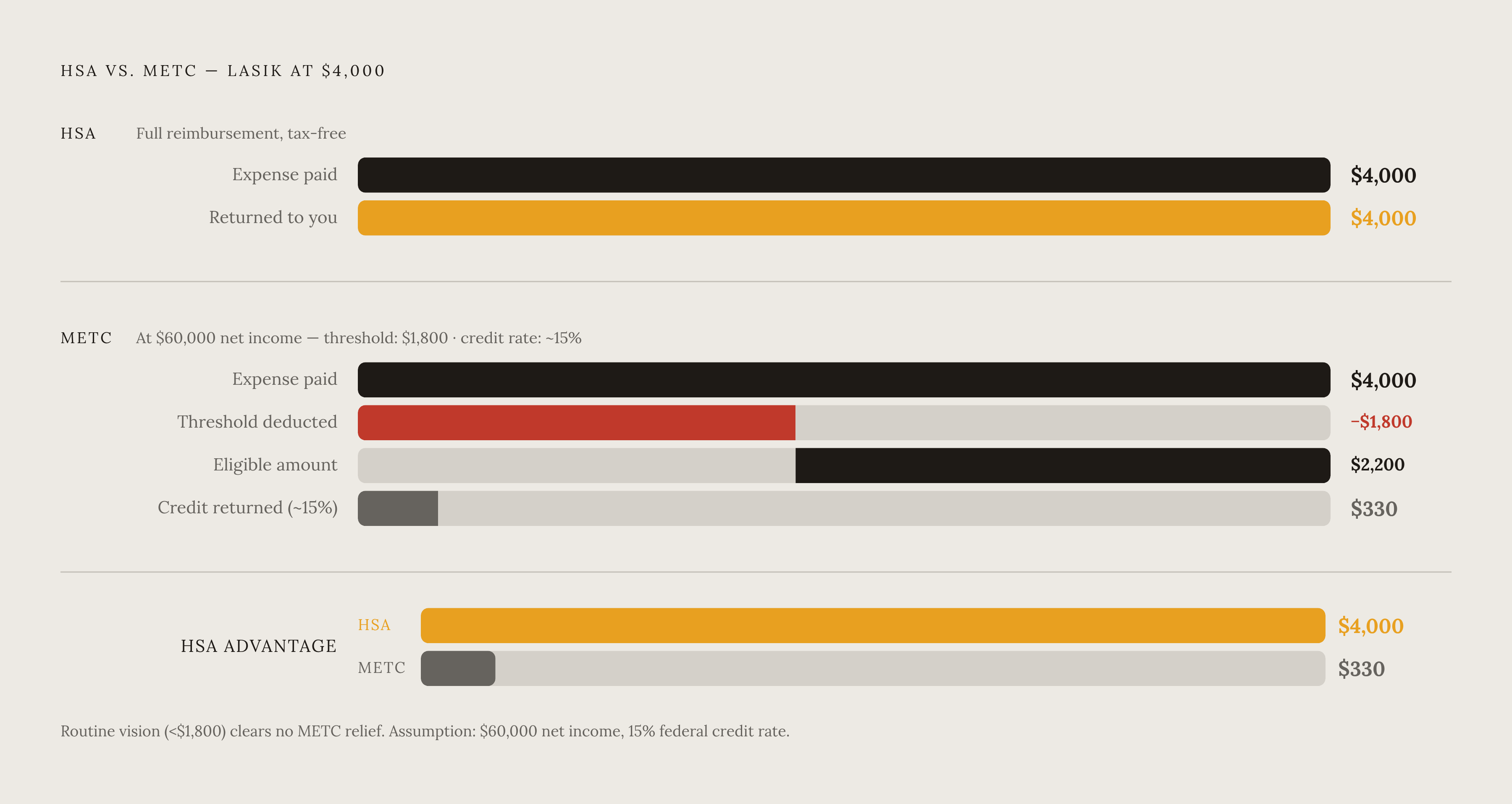
The METC is a tax credit, not a reimbursement, and that distinction matters more than it sounds like it should. It only returns a fraction of what was spent, and only on the portion of expenses that clear a threshold in the first place. For 2026, that threshold is the lesser of 3% of net income or $2,635 Health Spending Account (HSA) Canada Guide 2026 | CRA Rules & Eligibl… Health Spending Account (HSA) Canada Guide 2026 | CRA Rules & Eligibl…. Routine vision spending, an eye exam here, a pair of glasses there, often doesn't even get past that floor. It generates no tax relief at all through the METC.
An HSA works differently: the employee gets every dollar back, dollar-for-dollar. The corporation deducts the full expense, and the employee gets every dollar back with no federal taxable benefit attached. It's real money, often thousands of dollars in difference.
There's a sequencing rule. The same expense can't be claimed twice, once reimbursed through an HSA, it's off the table for the METC. So the smart order is to exhaust the HSA first, then claim whatever's left unreimbursed on the personal tax return. Quebec adds a wrinkle: employer HSA credits get taxed provincially under RL-1 Box J. That reduces the tax advantage somewhat, but it doesn't erase it. Consider LASIK as a practical illustration: at $2,000–$4,000 per eye, HSA reimbursement returns significantly more than the METC credit (if the expense even clears the threshold), a meaningful dollar figure, not a rounding error.
Vision benefit access for incorporated owners and self-employed Canadians
Incorporated business owners have more room to work with. CRA restrictions are lighter, annual claim maximums can generally be set higher, and vision expenses, including LASIK, flow through as a fully tax-deductible corporate expense.
Unincorporated self-employed individuals face a tighter setup, and it comes down to two real constraints. Annual PHSP deductions get capped by a formula tied to employee count and family size, so someone with no arm's-length employees can't just push unlimited personal medical expenses through a PHSP. And the plan can't include any element of income replacement. That's a hard line the CRA draws regardless of business structure.
Think about what happens when an incorporated owner pays for glasses or LASIK straight out of pocket instead of through a plan. They're giving up the corporate deduction and the tax-free receipt, effectively covering a personal health cost with after-tax dollars when a PHSP would have let the same expense flow through pre-tax. That's a quiet but real cost, one that compounds over a few years of routine vision spending.
A pay-as-you-go HSA structure, with no setup or annual fee and typically an 8–10% administration fee on approved claims only (varies by provider), keeps costs proportional to actual use. A business with a quiet, low-claim year isn't paying premiums for coverage nobody touched. That matters specifically for vision spending, which tends to be lumpy: years of nothing, then one large event like LASIK. The HSA annual credit is set by the employer, with a common range of $500–$3,000 per year, and the business owner controls this figure at plan design.
Timing large vision claims strategically within the plan year
HSA funds run on an annual cycle, and the CRA doesn't allow carrying expenses back to a previous plan year, nor does it allow shifting unused credits between allocation categories. Whatever isn't used inside the window it belongs to is simply gone.
Carry-forward rules depend on the specific plan, some allow a one-year carryforward, others run strictly use-it-or-lose-it. A large vision expense that misses the claim window can mean losing the reimbursement entirely, which is a frustrating way to find out the rule existed.
Timing matters for something like LASIK.
Claims also have to reflect a real, already-incurred expense. Pre-submitting or claiming ahead of the actual procedure isn't allowed. And the annual credit limit is fixed once the plan year starts, it can't be bumped up mid-year. If a LASIK procedure ends up costing more than what's left in the current year's balance, that excess isn't automatically picked up. Anyone expecting a large vision expense needs to plan the credit amount at the design stage, not after the fact. The strategic implication is to schedule high-cost vision procedures (especially LASIK at $2,000–$4,000 per eye) early in the plan year to maximize the window for claim submission and reimbursement processing. Reimbursement for approved claims typically processes within 3–10 business days by EFT, which is worth factoring in when timing a claim near year-end.
Documentation to keep on file for vision care claims
Every vision claim needs an original receipt showing the patient's name, the provider's name, the date of service, a description of what was provided, and the amount paid. Missing any one of those fields is a common reason claims bounce back for more information.
For prescription eyewear, the prescription itself, issued by a licensed optometrist or ophthalmologist, is the document that actually proves eligibility. Keep it alongside the purchase receipt, since the receipt alone often doesn't show that the lenses were corrective.
For laser eye surgery, hang onto documentation from the surgical provider that shows the procedure performed and confirms the practitioner's credentials. What qualifies is specifically the amount paid to a licensed medical practitioner or hospital, so that paperwork needs to make the payment chain clear.
If another insurer or a group benefit plan already covered part of the expense, only the leftover, unreimbursed portion can go through the HSA. Receipts should reflect what was actually paid out of pocket after any other coverage kicked in.
Family claims work the same way as individual ones, receipts just need to clearly show the patient's name. A receipt in the account holder's name for a child's glasses still processes fine as long as the child's name shows up somewhere on it.
Most of this paperwork burden shrinks considerably with digital submission. Digital submission on a platform that lets claimants photograph and upload receipts removes the paperwork burden, with approved claims reimbursed by EFT typically within 3–10 business days.
Sources
- Health Spending Account (HSA) Canada Guide 2026 | CRA Rules & Eligible Expenses | WealthNorth
- Health Spending Account (HSA) Canada Guide 2026 | CRA Rules & Eligible Expenses
- HSA Eligible Expenses Canada: 2026 CRA List | Frontier HSA
- Medical Expenses 2025 - Canada.ca
- Are Eye Exams, Glasses and Contacts Covered by Your HSA in Canada? | Hiveworks
- Private health services plan
- HSA Eligible Expenses in Canada: Complete 2026 Guide | GoKlaim
- Health Spending Accounts for Self-Employed Canadians (2026) | Aeva