Multi-Class HSA Plan Design for Small Businesses
Tiered HSA contributions require careful plan design to avoid costly tax penalties.

Multi-Class HSA Plan Design for Small Businesses.
Why small businesses struggle to implement tiered HSA benefits
A multi-class HSA plan lets a small business set different contribution levels for different groups of employees. Done right, it's a legitimate tool that saves real money. Done wrong, it triggers an excise tax that wipes out whatever the plan was supposed to save, and this is where most small employers actually land.
Roughly six in ten small firms offer some kind of health benefit, even though most are in the 5-to-50-employee range where federal law doesn't require them to offer anything at all https://hsaforamerica.com/blog/small-business-group-health-benefits-costs-and-options/. Nobody forces these businesses to provide coverage. They do it anyway, because hiring gets harder without it, and because average family premiums at small firms hit $23,621 in 2023, with workers covering about $8,334 of that themselves, roughly 38% of the total https://ilhealthagents.com/insurance-news/ultimate-guide-hsas-small-business-owners/.
Faced with numbers like that, the instinct is obvious: if the business is paying, pay differently for different groups. More for full-time salaried staff, less for part-time hourly workers, something separate for the executive team. That instinct isn't wrong on its own. Where it goes wrong is what happens next, when employers start treating HSA contributions like a salary decision, something adjustable person by person based on tenure or a manager's judgment call. That's the single biggest misunderstanding driving compliance failures in this space. HSA contributions sit inside a federal framework with specific rules about who can get what, and those rules don't bend because the business has a good reason for the distinction it wants to make.
The 2026 thresholds for HSA-eligible plan qualification
One condition has to be true before any class design conversation matters: every employee receiving an employer HSA contribution has to be enrolled in a High Deductible Health Plan that actually qualifies as an HDHP. No HDHP enrollment, no HSA contribution, full stop. It doesn't matter how well drawn the classes are or how good the reasoning behind them sounds.
For 2026, the IRS sets the deductible floor at $1,700 for self-only coverage and $3,400 for family coverage https://taxguidance.org/irs-high-deductible-health-plan-2026-limits-and-hsa-eligibility/. Out-of-pocket maximums cap out at $8,500 for self-only and $17,000 for family https://taxguidance.org/irs-high-deductible-health-plan-2026-limits-and-hsa-eligibility/. Those numbers shift a little each year, but the structure holds steady: a floor on the deductible, a ceiling on total out-of-pocket exposure.
This matters most for employers considering different HDHP options for different classes, say, a lower-deductible plan for salaried staff and a higher-deductible one for hourly workers. Each plan option has to clear the threshold on its own. There's no averaging across plans and no borrowing eligibility from one design to cover another. A plan either meets the deductible floor and stays under the out-of-pocket ceiling, or it fails to qualify as an HDHP, period.
The ACA out-of-pocket ceiling and the HDHP out-of-pocket ceiling are not the same, and a plan that clears ACA cost-sharing rules may still fail HDHP qualification. The ACA ceiling for 2026 runs to $10,600 for an individual and $21,200 for a family https://www.ahix.com/blog/hsa-contribution-limit-2026/. The HDHP ceiling sits tighter, at $8,500 individual and $17,000 family. An HSA-qualified HDHP has to stay under the more restrictive HDHP number. A plan can satisfy every ACA cost-sharing requirement and still fail HDHP qualification if its out-of-pocket max is somewhere between those two figures. These two paths run under entirely different regulatory regimes, and the class flexibility available under each is nothing alike. For reference, 2025 thresholds were $1,650 / $3,300 deductible and $8,300 / $16,600 out-of-pocket maximum.
The compliance fork: why the funding mechanism determines everything about class flexibility
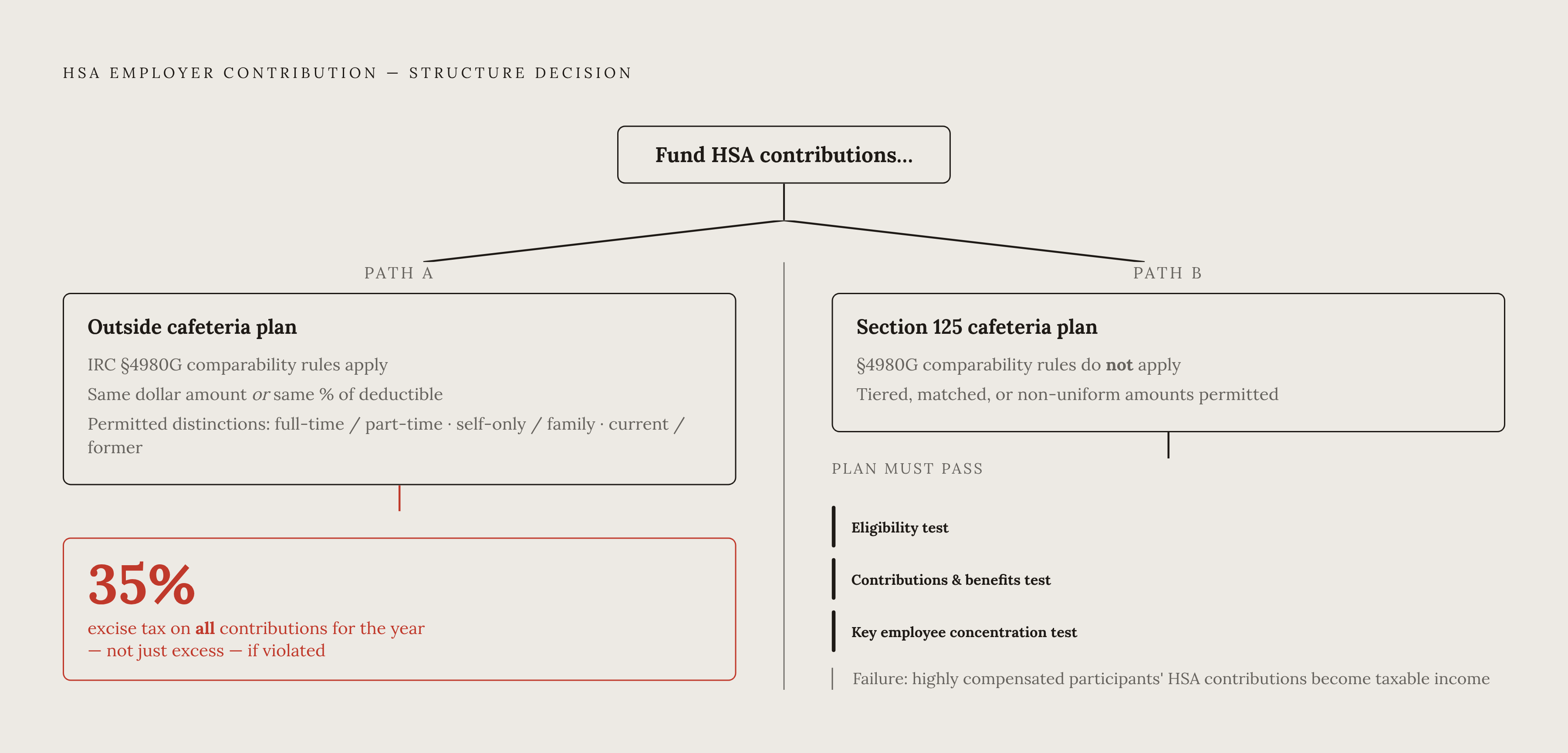
The decision that matters more than any class design question is how the employer funds these contributions in the first place. Outside a cafeteria plan, or through a Section 125 cafeteria plan? Whichever one the employer picks first, everything downstream follows from that choice. Get this wrong at the start, and no amount of careful class design later fixes it.
These two paths run under separate regulatory regimes entirely, and the class flexibility available in one bears almost no resemblance to what's available in the other.
Path A, funding outside a cafeteria plan, falls under IRC §4980G, the comparability rules. "Comparable" has a specific meaning here: the same dollar amount, or the same percentage of the HDHP's annual deductible limit, applied to comparable participating employees. "Comparable participating employees" means employees in the same employment category, enrolled in the same category of HDHP coverage. The rules allow some differentiation: full-time versus part-time can get different amounts, self-only versus family coverage can get different amounts, current employees versus former employees can get different amounts or nothing at all. What the rules flatly forbid is variation within a single box. An employer cannot give one full-time self-only employee $1,500 and another full-time self-only employee $800. No case-by-case discretion, no manager's judgment call, no "she's been here longer so she gets more."
Path B, funding through a Section 125 cafeteria plan, escapes §4980G entirely. Section 125's own nondiscrimination rules take over instead. Tiered contributions, matching formulas, and non-uniform amounts by category are where the real flexibility appears. But cafeteria plans charge a price of admission. The plan has to pass an eligibility test, a contributions-and-benefits test, and a key employee concentration test, and failing one of them lands the consequence specifically on highly compensated participants, whose HSA contributions turn into taxable income. Rank-and-file employees walk away unaffected.
The fork isn't a minor procedural choice. It decides whether the business operates inside a rigid grid of same-amount-per-box, or a more flexible system that carries its own separate set of tests to pass.
Structuring classes under the comparability rules when there is no cafeteria plan
Working outside a cafeteria plan means working inside a fairly narrow grid. Permitted distinctions include full-time versus part-time, self-only versus family HDHP coverage tiers, and current versus former employees. Each axis can carry its own contribution level, and combining them however the business needs is fine.
What the grid doesn't allow is variation inside a single box. Two full-time employees, both on self-only coverage, sit in the same box together, and the comparability rule says their contribution has to match.
Picture a small employer with full-time and part-time staff, each enrolled in either self-only or family coverage. That's four boxes total, four comparable groups. The employer can set a different contribution for each of the four (full-timers on family coverage might get more than part-timers on self-only), but everyone inside a given box has to receive the same amount. Consistency within the box, freedom across boxes. That's the whole model.
Get it wrong, and the penalty isn't gentle. The federal rules include a worked example: an employer contributes $2,000 each to two employees and $1,000 each to six others, for a total of $10,000 in contributions https://www.ecfr.gov/current/title-26/chapter-I/subchapter-D/part-54/section-54.4980G-1. Employers who violate the comparability rules face a 35% excise tax on all HSA contributions for the year, which in that example means $3,500, 35% of the full $10,000 https://www.peoplekeep.com/blog/employer-contributions-to-hsa https://www.ecfr.gov/current/title-26/chapter-I/subchapter-D/part-54/section-54.4980G-1. That tax applies to every dollar contributed that year, not merely the excess amount. It's a tax on every dollar contributed that year, including the contributions that would have been perfectly fine standing on their own, and that mechanism makes a comparability violation so much more expensive than the mistake that caused it.
The nondiscrimination limits on the Section 125 cafeteria plan route
Escaping §4980G opens up a level of design flexibility the comparability path simply doesn't offer. Employers can run matching contributions, where the business matches what an employee puts into their own HSA up to some ceiling. They can set flat, non-uniform amounts by category, say $1,200 for salaried staff and $600 for hourly staff. They can seed accounts at the start of the plan year with different amounts for different defined classes.
The Uniform Election Rule is what keeps this flexibility from turning into a loophole for funneling money to executives. The rule says an employer cannot contribute more to a highly compensated participant's HSA than to a non-highly-compensated participant eligible for the same HDHP option who's "similarly situated". It exists specifically to stop a business from inventing a flattering class label just to route bigger contributions toward management while lower-paid staff on the identical plan get less.
The carve-out that makes legitimate tiering possible is the "similarly situated" test itself. If the non-highly-compensated employees getting the lower contribution genuinely aren't similarly situated to the highly-compensated ones getting more, the gap is allowed. What establishes that someone isn't similarly situated comes down to real, structural differences: hourly pay versus salaried pay, a different office or region, enrollment in a different HDHP option altogether. What doesn't count is a class invented after the fact to justify a contribution the business already wanted to make. Under a cafeteria plan, employer HSA contributions sidestep §4980G entirely, so tiered contributions, matching formulas, and variable amounts by class can exist here without triggering the comparability excise tax.
The simple cafeteria plan safe harbor for very small employers
For employers with 100 or fewer employees, the IRC §125 simple cafeteria plan safe harbor offers a shortcut: the plan is treated as automatically meeting the applicable nondiscrimination tests for any year its own requirements are satisfied.
The trade is uniformity. The safe harbor requires the same contribution be made available to every eligible employee. Skip the nondiscrimination testing, but give up the ability to differentiate contributions by class inside that structure. That's the whole bargain.
For a genuinely small employer, well under the 100-employee mark, whose only goal is offering some employer HSA contribution without worrying about discrimination exposure, this is about as low-friction as compliance gets. Set the contribution, make it available to everyone, done.
It doesn't solve the problem of tiering contributions by employee class, and it was never built to. An employer that wants to give salaried staff $1,500 a year and part-time hourly staff $500 a year can't get there inside the simple cafeteria plan safe harbor. That circles back to the fork covered earlier: the decision that actually matters is whether the employer funds outside a cafeteria plan or through a Section 125 plan. The safe harbor is built for businesses that want simplicity over tiering. Asking it to deliver both at once is asking it to be something it was never designed to be.
Defining employee classes that will hold up to CRA scrutiny
Everything above rests on one final piece: the class itself has to be real. Whichever framework is doing the reviewing, the signal being checked for is the same, a distinction that reflects an actual difference in employment terms, not a label invented after the fact to produce a contribution number the business already wanted.
What tends to hold up: full-time versus part-time status, salaried versus hourly pay structure, geographic distinctions between offices or regions, and job category divisions like management versus production staff. These categories describe something true about how the business actually runs. They existed before anyone thought about HSA contributions, and they'd still exist if the HSA program vanished tomorrow. A class written into the plan document before any contribution gets made carries far more weight than one assigned afterward to explain a decision retroactively.
What falls apart under scrutiny is easy to spot once it's named. A "class" that lines up exactly with compensation level, with no other distinguishing trait attached, reads as a salary tier wearing a costume. A class whose membership shifts constantly, with no fixed criteria for who's in or who's out, can't be defended because there's nothing stable to point to. The distinctions that survive are the boring, structural ones: hours worked, pay basis, location, role. None of that is clever. It's just true, and durable enough to explain itself without a lawyer in the room.
For a Canadian small business audience working with a Canadian HSA administrator, this is the standard the CRA applies, and it runs on the same structural logic. About six in ten small firms provide some type of health benefit https://hsaforamerica.com/blog/small-business-group-health-benefits-costs-and-options/. For 2026, HSA contribution limits are $4,400 for individual coverage and $8,750 for family coverage https://www.fidelity.com/go/hsa/small-business-hsa. Individuals age 55 or older during the tax year may make a catch-up contribution of up to $1,000 per year https://www.fidelity.com/go/hsa/small-business-hsa. For 2027, the HSA contribution limit rises to $4,500 for self-only coverage and $9,000 for family coverage https://narfa.com/hsa-changes-2027-employer-guide/. In 2025, an HSA-eligible HDHP had to have a deductible of at least $1,650 for self-only coverage https://ilhealthagents.com/insurance-news/ultimate-guide-hsas-small-business-owners/. In 2025, an HSA-eligible HDHP had to have a deductible of at least $3,300 for family coverage https://ilhealthagents.com/insurance-news/ultimate-guide-hsas-small-business-owners/. In 2025, HDHP out-of-pocket maximums were capped at $8,300 for self-only coverage https://ilhealthagents.com/insurance-news/ultimate-guide-hsas-small-business-owners/. In 2025, HDHP out-of-pocket maximums were capped at $16,600 for family coverage https://ilhealthagents.com/insurance-news/ultimate-guide-hsas-small-business-owners/. Alternatives like HRAs, HSA-compatible plans, and health sharing programs can reduce employer costs by 30-50% https://hsaforamerica.com/blog/small-business-group-health-benefits-costs-and-options/. Most benefit setups require 60-90 days of lead time before benefits begin https://hsaforamerica.com/blog/small-business-group-health-benefits-costs-and-options/.