Most Tax-Efficient Ways to Cover Medical Costs Through a Canadian Corporation
Save 30% on medical costs by running expenses through your corporation instead of personal income.

Every dollar an incorporated business owner spends on medical care starts as corporate income, gets taxed on the way out, and only then becomes spendable cash. That's the whole inefficiency this piece is about, and the fix is routing health spending through the corporation instead of the owner's personal bank account. Get this wrong, and an owner is quietly handing the government tax on money that never needed to leave the business in the first place.
Pull money out of a corporation as salary or dividends, and personal income tax applies before a dollar of it reaches a pharmacy counter. At a 43% marginal rate, buying $1 of medical care means the corporation has to hand over roughly $1.78 first. Seventy-eight cents evaporates into personal tax before a single prescription gets filled.
Compare that to how the corporation itself gets taxed. A qualifying private corporation claiming the small business deduction pays a net federal rate of 9%. Add provincial tax, and the combined rate is somewhere between 9% and 12.2% on the first $500,000 of active business income. That's the gap that matters: a spread of 30 points or more against a personal marginal rate north of 43%.
Provincial rates move year to year, so the exact spread depends on where the business operates. Nova Scotia, for instance, raised its small business deduction limit to $700,000 and cut its rate to 1.5%, effective April 1, 2025. Whatever the local numbers are, the direction of the gap doesn't change: corporate income gets taxed lighter than personal income, every time, in every province. That gap is the entire reason to look hard at how medical costs move through a business. Nothing here is a loophole. It's arithmetic, and ignoring it costs real money every single year it stays ignored.
How a Private Health Services Plan converts medical costs into a corporate deduction
The tool that makes this work is a Private Health Services Plan, or PHSP. CRA recognizes it as a structure that lets an employer reimburse employees for eligible medical costs. The industry also calls it a Health Spending Account (HSA), a Cost Plus plan, or a Health Care Spending Account. Different name tags, but the same mechanism produces each one, as the shared structure across the HSA, Cost Plus plan, and Health Care Spending Account labels shows.
The benefit runs two directions at once. On the corporate side, every dollar spent reimbursing an employee, plus whatever fee the plan administrator charges, reduces taxable corporate income as a straight business expense. On the employee side, and that includes an owner sitting on payroll, the reimbursement never touches a T4. No personal income tax applies to money received through a properly structured PHSP.
The mechanics are almost mundane. The owner pays for an eligible medical expense out of pocket and keeps the receipt. That receipt goes to a third-party HSA administrator, who reviews the claim, reimburses the owner, then bills the corporation. The corporation deducts the full invoice, original expense plus admin fee, as a business expense. Administrator fees typically run in the range of 5% to 10% of approved claims, and that fee rides the same deduction as the medical cost itself.
The plan has to be documented properly: either through a third-party provider's paperwork, or a written internal policy if self-administered. Reimbursements need to flow through the corporation's books. Money moving straight from the owner's personal account to their own pocket, skipping the corporate ledger entirely, is the kind of shortcut that unravels the whole arrangement.
CRA's rule states that medical expenses paid under a qualifying PHSP aren't a taxable benefit to the employee. Skip the qualifying structure, and employer reimbursements of medical costs generally become taxable. That difference, qualifying or not, is the entire plan.
What the savings look like in dollar terms
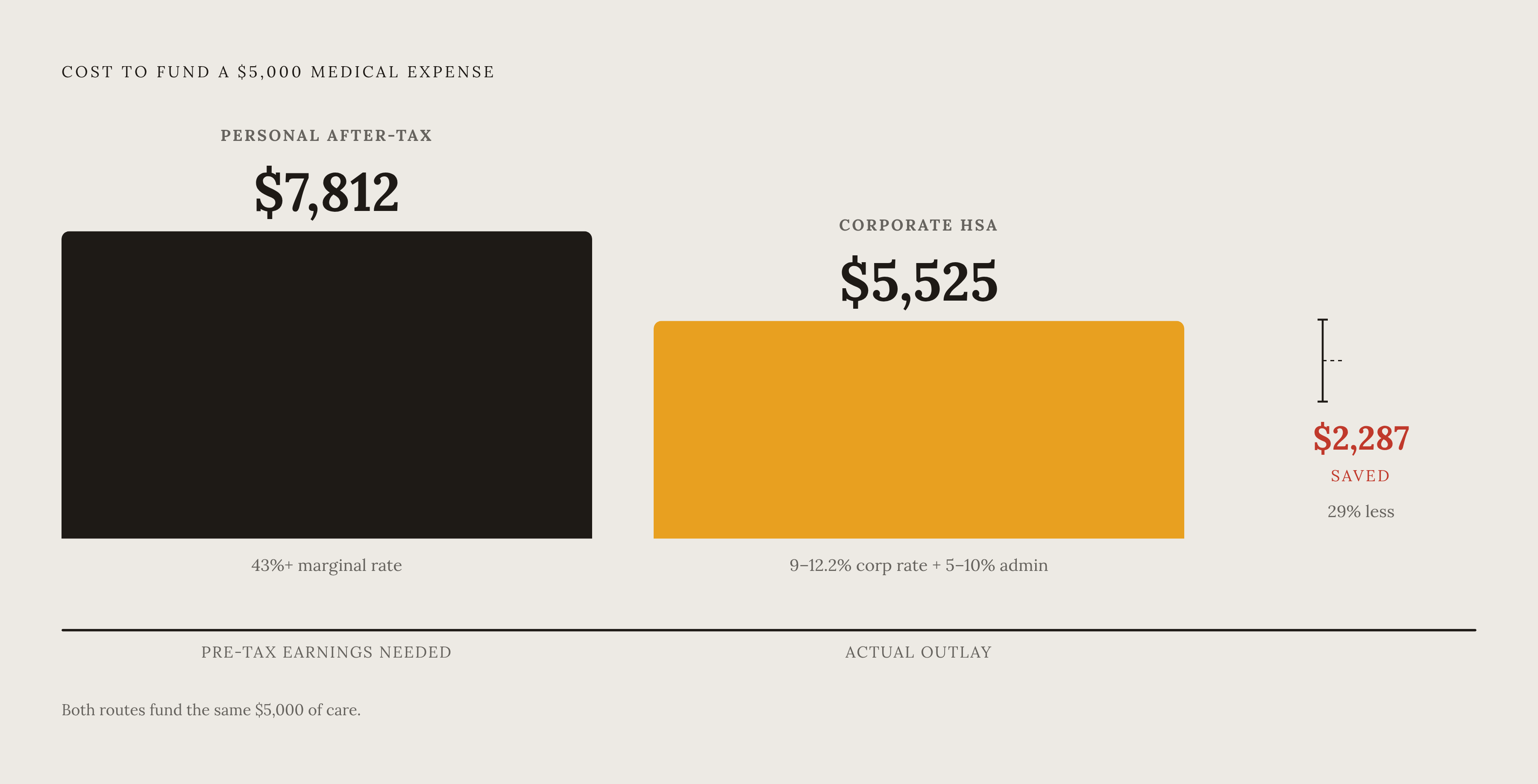
Take a $5,000 medical expense. Route it through an HSA, and the total cost, including the administrator's fee, comes to $5,525. Pay the same expense with personal after-tax dollars, and the cost balloons to $7,812.50. That's a savings of $2,287.50, or 29%, just from changing which account the money comes out of.
A smaller, more grounded example makes the point without inflating it: an Ontario owner-shareholder earning $100,000 in salary with $3,000 in medical expenses saved $609.14 by running those costs through an HSA instead of pulling extra salary to cover them. Not a life-changing figure on its own, but a saving that repeats every year the plan stays in place, and compounds the longer it runs.
The mechanism behind both numbers is the same one from the opening section. The corporate small business rate, somewhere between 9% and 12.2%, absorbs the expense instead of the owner's personal marginal rate. That rate spread is where the money comes from, full stop. Actual savings shift with province, the mix of salary versus dividends an owner takes, and the size of the HSA's annual limit. The figures above illustrate the principle. They aren't a guarantee for every business, but the direction of the saving never flips.
CRA's qualification rules for a plan to be recognized as a PHSP
CRA doesn't hand out PHSP status just because a business calls its arrangement one. The core test is the 90% rule: at least 90% of the premiums or contributions paid under the plan have to go toward expenses that qualify for the Medical Expense Tax Credit (METC). That covers prescriptions, dental work, vision care, hospital costs, and related expenses under section 118.2(2) of the Income Tax Act, a wide list that also reaches paramedical services like physiotherapy or massage, and certain mental health services.
Spouses and dependent children can join the plan, but they need to be enrolled when the plan is set up. Adding a dependant retroactively, after an expense has already happened, generally doesn't work.
There's no statutory dollar cap for incorporated businesses. CRA applies a reasonableness test instead of a hard number, and the employer sets the coverage amount within that test. The industry has settled on rough benchmarks anyway: $15,000 a year tends to get treated as a reasonable upper limit for a family, and a common rule of thumb applied by some HSA providers holds that the HSA credit cannot exceed 20% of the employee's gross T4 salary.
Unincorporated businesses face a harder line. CRA won't recognize a self-administered cost-plus arrangement run by a sole proprietor as a genuine insurance-like plan. Third-party administration is required there, full stop. Incorporated businesses get more room, and are permitted to self-administer, though most still bring in a third-party administrator for the credibility it adds when CRA comes asking questions.
Benefits also need to stay reasonable and consistent across similar employee classes. What the plan gives an owner-employee has to hold up against what an arm's-length employee doing comparable work would receive. That comparison sounds like a formality until it becomes the central question in the next section.
The shareholder-employee condition and its compliance challenges
CRA's foundational rule is specific: PHSP benefits paid to a shareholder only qualify when the shareholder receives them in their capacity as an employee. CRA Technical Interpretation 2003-0050541E5 requires the shareholder to be actively engaged in the business, with benefits that stay reasonable and consistent with what an arm's-length employee in a similar role would get.
The sharpest edge appears for sole shareholder-employees, a corporation with exactly one person on payroll. CRA has taken the position that a self-insured HSA set up for a single employee-shareholder and their family would likely fail to qualify as a plan in the nature of insurance, which means it fails to qualify as a PHSP at all.
Failing that test is expensive in a very specific way. The reimbursement becomes a taxable benefit to the shareholder, and it's non-deductible to the corporation at the same time, the same dollar taxed twice. That double hit defeats the entire point of setting the plan up.
A sole-shareholder plan gets stronger with three concrete moves. Use a reputable third-party administrator, since self-administering a one-person plan is the weakest position possible. Add at least one arm's-length employee to the plan, a single change that goes a long way toward giving the arrangement genuine insurance character. And take actual T4 salary from the corporation: owners who take only dividends stand on shakier ground, which is why many accountants recommend at least a modest salary specifically to support HSA eligibility.
Reasonableness gets judged by comparison. If an arm's-length employee in a similar role receives a $2,000 HSA benefit, giving the owner the same amount holds up fine. Give the owner meaningfully more, and the excess invites CRA scrutiny as a shareholder benefit dressed up as an employment benefit.
Quebec residents carry an added wrinkle. Amounts reimbursed through an HSA are taxable under Quebec's provincial rules and need to be reported to Revenu Québec. Federal tax-free treatment still applies, but the provincial benefit shrinks considerably for anyone filing there.
None of this makes the PHSP risky to the point of avoiding it. The risk is administrative, and it's manageable with the right setup from the start. The goal is informed compliance, not steering clear of a mechanism that works.
HSA versus a traditional group benefits plan for a small incorporated business
An HSA and a traditional group benefits plan solve different problems. Treating them as competing options, and picking one on reputation alone, is the mistake most small business owners make here.
HSAs have a clear edge on routine cost. The employer only pays for expenses that actually happen, so no money gets spent on coverage nobody used. Contributions are deductible, reimbursements are tax-free to employees, and eligibility is based on the CRA's list of qualifying medical expenses rather than an individual's health history. The employer also sets a fixed annual budget, which makes total cost predictable in a way insurance premiums rarely are.
Traditional group plans earn their place for one reason, and it's decisive: catastrophic coverage. A serious diagnosis, or a prescription drug priced far above any HSA limit, gets absorbed by an insured plan. A modest HSA limit, even a generous one, doesn't touch that kind of risk. Group plans also bundle in life insurance, disability insurance, critical illness insurance, and accidental death and dismemberment coverage, none of which an HSA replicates on its own.
Cost structure differs too. On a typical fully insured plan, premiums include a component that covers the insurer's risk transfer and margin beyond the value of claims paid out. An HSA carries no such spread, since the employer only pays for what actually gets claimed.
The businesses that get this right usually run both: a group plan for catastrophic and disability risk, an HSA for routine, predictable costs like dental cleanings, prescription glasses, and physiotherapy. Betting everything on one product means leaving a real gap in coverage on one end or the other.
The Medical Expense Tax Credit as a fallback for those outside a corporate plan
For anyone without access to a corporate plan, the Medical Expense Tax Credit is the tool left standing. It's a non-refundable federal tax credit claimed on a personal return, so it can bring tax owed down to zero, but it generates no refund past that point.
For 2025, the federal credit rate is 14.5% of eligible expenses. There's a threshold too: eligible expenses need to clear the lesser of 3% of net income or $2,834, and only the amount above that line generates a credit. Some timing flexibility softens the threshold, since a taxpayer can claim expenses from any 12-month period ending in the tax year, useful for clustering expenses together to clear the bar faster.
A sample calculation shows how thin this credit runs in practice. At $100,000 net income in Alberta, $4,000 in eligible medical expenses produces an METC of roughly $394.75, a small return relative to what actually got spent.
One firm rule cuts across every scenario: the same expense can't be claimed under both an HSA and the METC. Only one mechanism touches any given dollar.
This is exactly why an HSA wins whenever it's available. An HSA makes the entire expense deductible at the corporate level. The METC only credits the sliver above the threshold, at a fairly low rate on top of that. The METC's relief ends up being a fraction of the expense, while the HSA removes personal tax from the whole amount, no threshold, no ceiling on the percentage.
The METC still has a job for incorporated owners without a PHSP running yet, for personal expenses that fall outside whatever an HSA covers, and as a planning lever between spouses. The lower-income spouse should generally claim the family's medical expenses, since the 3%-of-net-income threshold is easier to clear on a smaller income.
Sole proprietors' standing and why incorporation changes the calculus
Sole proprietors run into a wall incorporated owners never see. A sole proprietor can only set up a PHSP by employing at least one arm's-length worker, someone who isn't a spouse, child, or other family member unless that family member is genuinely working at arm's length from the business.
Even clearing that bar, the benefit is capped hard: $1,500 a year, or $750 with no dependants. That's a fraction of what an incorporated business can offer through the identical type of plan.
For a sole proprietor spending well above those caps every year on medical costs, that ceiling by itself is a real argument for incorporating. An incorporated structure removes the statutory limit entirely and opens the full range of the corporate deduction mechanism covered earlier.
Without a qualifying PHSP, unincorporated individuals fall back completely on the METC, the weakest tool of the group by a wide margin.
Incorporating purely to unlock better health benefits is putting the cart before the horse. Legal liability, administrative overhead, and other factors outweigh medical cost planning in that decision. Still, the gap in benefit access between a sole proprietorship and a corporation is concrete and measurable, so it should be raised with an accountant before assuming the current structure is the right one long-term.
Putting the mechanisms together: which structure fits which situation
The right structure depends on how the business is set up and how the owner draws income. A few patterns repeat often enough to count as rules.
An incorporated owner drawing T4 salary, with at least one arm's-length employee on payroll, is in the strongest position for a standalone HSA. Third-party administration, a properly documented plan, and benefit levels that hold up against what employees receive: that combination delivers the most efficiency the rules currently allow.
An incorporated sole shareholder taking only dividends sits in a weaker spot, per CRA's guidance on self-insured single-employee plans. Adding even a modest T4 salary strengthens that position considerably, and it should happen before the plan gets set up, not after CRA flags it.
An incorporated owner facing high or unpredictable medical costs needs the hybrid: a group plan for catastrophic and disability risk, an HSA for routine, predictable expenses. Neither tool alone covers both ends of that range.
A sole proprietor with eligible arm's-length employees has PHSP access, but it's capped at $1,500 or $750 a year. The METC stays relevant for costs the plan doesn't touch, and incorporation is worth modeling seriously once annual medical spending runs consistently past those caps.
A sole proprietor with no eligible employees is left with the METC alone. The 12-month timing flexibility and the lower-income-spouse strategy are the only real levers available in that position, and neither one closes the gap with a corporate plan.
Quebec residents need to weigh all of this differently, since provincial tax applies to HSA reimbursements regardless of the federal tax-free treatment. That reduction has to get built into any savings estimate before committing to a structure.
Across every scenario here, the plan has to get set up correctly from day one: documented properly, administered through a legitimate third party where required, and checked against CRA's reasonableness standard before the first dollar gets reimbursed.
Sources
- Medical Expenses 2025 - Canada.ca
- Tax-Efficient Health Benefits for Incorporated Businesses in Canada
- Understanding the Medical Expense Tax Credit (METC) in Canada | Garrett Agencies
- 2024 tax credit for medical expenses | Normandin Beaudry
- formusazuccaro.ca
- Medical expenses, including payments from a private health services plan (PHSP) - Canada.ca
- jonescosman.com