How a Health Spending Account Works in Canada
Employers can fund employee medical bills tax-free if they follow CRA's strict rules.

Health Spending Accounts let a Canadian employer pay employee medical and dental bills without either side owing tax on the money. Most people assume this works like flexible spending accounts south of the border, or worse, like some kind of insurance product. It is neither a flexible spending account nor an insurance product. The employer sets a spending limit per employee, the employee submits real receipts, and the plan reimburses those claims tax-free. Where compliant plans turn into taxable messes is almost always the same place: owners underestimate how strict the CRA rules are behind that simple mechanism.
HSA, Health Care Spending Account (HCSA), and Private Health Services Plan (PHSP) all mean the same thing. Accountants, insurers, and plan administrators swap the three names without thinking twice, so a different acronym on a document doesn't signal a different product. Drop any comparison to a similar account used in another country, where an individual funds their own account with pre-tax dollars and owns the balance. Canadian employees contribute nothing and own nothing. What they get is a spending allowance the employer funds, dollar for dollar, only as claims land.
The legal foundation: why CRA recognizes HSAs as tax-free benefits
An HSA gets tax-free treatment for one reason, and one reason only: it qualifies as a Private Health Services Plan under the Income Tax Act. That classification is what makes employer contributions deductible and employee reimbursements untaxed. Lose the classification, and the whole arrangement reads as extra pay, taxed the same way a raise would be.
Four conditions make a plan a PHSP. It has to cover the medical and hospital expenses listed in section 118.2(2) of the Income Tax Act. It needs to exist on paper, either through a third-party provider's plan documents or a written internal policy. Benefit limits have to stay reasonable and apply consistently across similar groups of employees, never handed out on a whim. And the money has to move through the corporation itself, never straight from an owner's personal account.
CRA guidance also runs a math test, the "all or substantially all" rule: at least 90% of what a plan pays out has to go toward expenses that would qualify for the Medical Expense Tax Credit. A plan that directs the vast majority of payouts toward METC-eligible expenses will clear that bar.
The condition that trips up the most owners is the risk requirement. A PHSP has to function like insurance, meaning real uncertainty about whether and how much an employee will claim in a given year. Building a plan so a specific person is guaranteed to use it in a specific way removes that uncertainty, along with the tax advantage. CRA reclassifies plans like that as a taxable benefit, and it does so routinely. This is a legal test, and structuring around a sure thing fails it every time. It's a legal test, and structuring around a sure thing fails it every time.
Who is eligible to open and use an HSA
Not every business structure qualifies, and the gap between who does and doesn't is wider than most owners expect. Get this part wrong and nothing downstream matters.
Canadian incorporated businesses are the cleanest fit, including professional corporations for doctors, dentists, lawyers, and accountants. Non-profits qualify too. Sole proprietors and partnerships can set one up, but only with at least one arm's-length employee on staff, someone who isn't a relative of the owner. Holding companies don't qualify. Full stop, no workaround.
Incorporated professionals often use what's called a "class of one," where an owner with no other staff builds an HSA just for themselves and their dependants. CRA allows this single-person benefit class as long as the owner meets the underlying employment requirements, and that's exactly where a lot of owners trip.
A shareholder-employee needs actual T4 employment income to justify the benefit. An owner paid entirely in dividends, with no salary on the books, is standing on thin ice: CRA can view that setup as lacking the employment relationship the plan depends on. As a rule of thumb, annual HSA allocations shouldn't exceed roughly 20% of an employee's T4 income, with the allocation kept proportionate to that salary. If dividends are the only income showing up, adding a modest salary is what keeps the plan defensible.
Sole proprietors face tighter limits than incorporated owners: a typical annual deduction runs around $1,500 for the proprietor, their spouse, and dependants over 18, dropping to $750 for dependants under 18. Unincorporated businesses can run a PHSP, just at a fraction of the ceiling an incorporated business gets, and that gap shapes nearly every decision that comes next in building the plan.
Setting up the plan: employee classes and annual spending limits
Setting up an HSA follows a sequence, and skipping a step is usually what triggers a CRA problem months or years later.
Step one is grouping employees into classes based on similar duties and responsibilities, not job title alone. Think Part-Time Staff, Managers, Junior Accountants, Senior Web Developers. CRA cares about fairness here: two people doing essentially the same job can't land in different classes just because one negotiated a better deal. Smaller companies with a mix of titles can still group people together, as long as the actual day-to-day work lines up.
Step two is assigning a dollar figure to each class. Industry patterns run roughly $500 to $2,999 for regular staff, $3,000 to $7,999 for professionals and managers, $8,000 to $24,999 for senior staff, and $25,000 to $50,000 for executives, owners, and high earners, with a general ceiling of 25% of before-tax salary. A simple tiered structure might give executives $10,000 a year, managers $5,000, and full-time staff $2,500.
Step three is putting all of it in writing. Verbal understandings don't survive a review. The plan needs formal documentation, either from a third-party administrator or a written internal policy the company keeps on file.
A plan looks fair rather than like a workaround when the highest class limit runs no more than ten times past the lowest. If executives get $15,000, other groups need at least $1,500 to keep that ratio intact. Crossing that ratio makes the plan stop looking like a benefit structure and start looking like a mechanism for funneling tax-free money to the owner, drawing CRA scrutiny.
The annual allocation works as a ceiling. If employees only claim part of what they're allotted, the employer only pays for what actually got claimed, plus admin fees. Nobody writes a check for the full amount up front.
The reimbursement loop: how a claim moves from receipt to payment
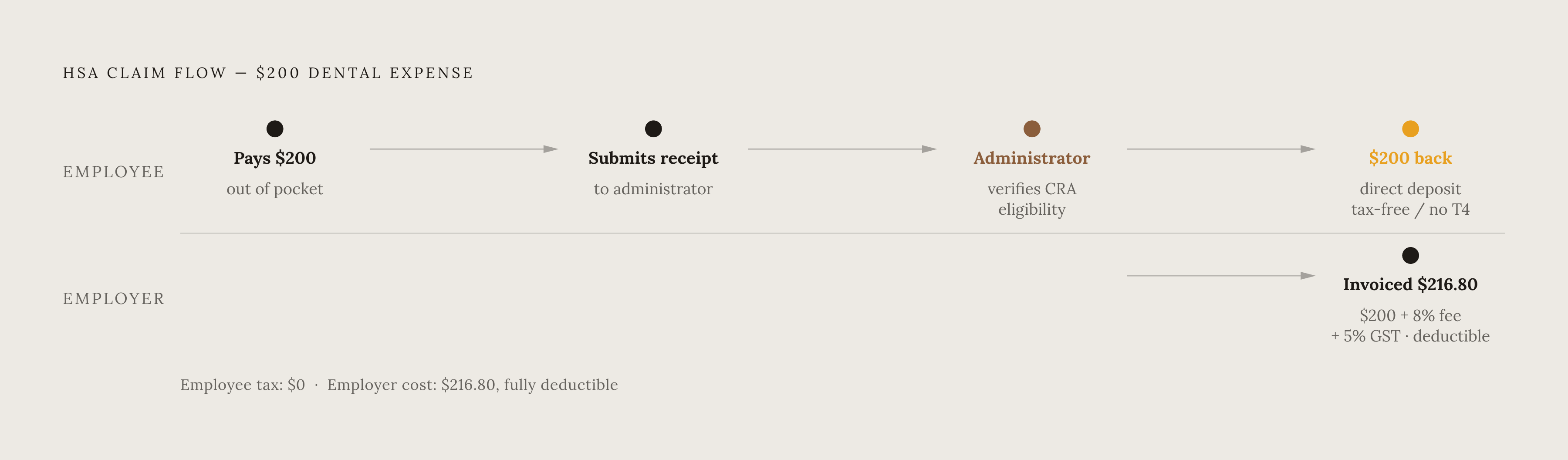
The mechanics here run simpler than most benefit plans, and that's by design.
An employee pays for something eligible out of pocket, a dental cleaning, a set of glasses, whatever it happens to be. They get a receipt and upload it through the HSA platform or send it to the administrator. The administrator checks the claim against CRA eligibility rules, and once it clears, the employee gets reimbursed from their available balance, usually by direct deposit. The employer gets billed for that claim amount plus an administration fee.
Take a $200 dental expense. The employee pays it, submits the receipt, and gets reimbursed $200. The employer then gets invoiced $200 plus an 8% admin fee plus 5% GST on that fee, landing at $216.80 total. The employer deducts the full $216.80 as a business expense. The employee reports none of the $200 as income, anywhere, ever.
Turnaround typically runs 2 to 5 business days for direct deposit, and the reimbursed amount never appears on a T4 or a personal tax return. It isn't income, by design.
Employees don't contribute to their own HSA. Contributions come from the employer, period. Money coming from the employee's own pocket would be after-tax dollars, which defeats the entire point of the structure.
Most owners don't run this claims process themselves. They use a third-party administrator (TPA) who reviews claims, keeps documentation straight, and runs the platform employees submit receipts through, typically for 5% to 10% of each claim, reducing the appearance that the shareholder-owner is self-approving. That's not just convenience. A shareholder-owner reviewing and approving their own claims makes the plan look like it lacks genuine risk, the same "insurance in nature" element CRA checks for. An arm's-length administrator keeps the process clean and gives the plan a clear audit trail if CRA comes asking.
What expenses are eligible for reimbursement
The baseline rule is simple: if an expense qualifies for the Medical Expense Tax Credit, it almost always qualifies for HSA reimbursement.
That covers dental care from routine cleanings to orthodontics and implants, vision care including glasses, contacts, and laser eye surgery, and prescription medications. It extends to physiotherapy, chiropractic care, massage therapy, naturopathy, and acupuncture, provided the practitioner holds a recognized provincial designation. Mental health services through a licensed psychologist, registered clinical counsellor, or psychiatrist fall under this too, and given how unevenly provincial health plans cover mental health across Canada, an HSA closes a real gap here rather than padding a benefit that already existed. Fertility treatments qualify. So does medical equipment: orthotics, hearing aids, CPAP machines, prosthetics, braces. Ambulance and hospital services, medical cannabis when prescribed, and medical travel round out the list, with longer-distance trips can cover transit or vehicle costs and, beyond certain thresholds, accommodation and meals as well.
A typical HSA covers over 100 distinct eligible expenses, and dependants count too: spouses, common-law partners, and household members connected by blood, marriage, or adoption, as long as they're financially dependent.
What doesn't qualify matters just as much, maybe more: this is where claims get denied. Gym memberships, fitness classes, and personal training don't meet CRA's definition of a medical expense, no matter their health benefit. Vitamins and supplements bought without a prescription are out. Cosmetic procedures without medical necessity don't count, and neither does general wellness spending: aromatherapy, meditation apps, over-the-counter skincare.
An expense can sit fully eligible on paper and still get denied over a technicality. A receipt missing key details, a prescription that never got attached, a required form left unsigned: any one of these sinks an otherwise valid claim. The eligibility rules matter, but the paperwork behind them decides just as many outcomes.
The tax outcome for employers and employees (and the Quebec exception)
This is where the structure earns its keep.
For the employer, every dollar moving through a compliant HSA counts as a fully deductible business expense, cutting corporate taxable income by the full amount of approved claims. Costs associated with administering the plan flow through the corporation as a business expense.
For the employee, the reimbursement arrives completely free of income tax, federal and provincial both. It never touches a T4 and never appears on a personal return.
Running the numbers shows the gap gets stark fast. An owner paying $3,000 out of pocket for dental and vision work might need something closer to $5,000 in pre-tax income to cover that cost once personal tax takes its cut. Routing the same $3,000 through an HSA instead means it comes back tax-free while the corporation deducts the full amount, with combined savings that typically run between 25% and 40% depending on the corporate tax rate.
Quebec complicates the math without erasing the advantage. Quebec treats the employer's annual HSA credit as a provincial taxable benefit, reported on the employee's RL-1 slip in Box J, and layers on its own health contribution rules with separate employer reporting requirements. The HSA still holds value for a Quebec employee, just a smaller one than elsewhere in the country. Any business with Quebec staff needs an administrator who knows the RL-1 reporting cold, not one running the rest-of-Canada playbook by default.
Setting the HSA next to the Medical Expense Tax Credit shows that, for an incorporated owner, the HSA wins almost every time. The METC is a personal, non-refundable credit anyone can claim, but for 2025 returns it only kicks in above the lesser of $2,834 or 3% of net income, and even past that threshold it's a credit, not a deduction. An HSA skips the threshold entirely and turns the same expense into a business deduction plus a tax-free reimbursement. For anyone spending real money on health care each year, that's not a close call, and treating the two options as comparable is where a lot of owners leave money on the table.
Unused funds and rollover rules at year end
CRA doesn't mandate one rollover policy across every HSA. That decision belongs to the employer, and three approaches dominate in practice.
Some plans roll unused funds into the next year automatically. Others may apply stricter rules around unused funds at year end. A third option splits the difference, allowing funds to carry forward for a limited period before they expire.
Many Canadian HSAs include some form of rollover provision, giving employees additional time to file a claim. Whether a given plan follows that pattern comes down entirely to how the employer designed it, and two companies can run genuinely different rollover rules while both staying fully compliant.
Strict "use it or lose it," where funds vanish the moment the calendar flips, isn't something CRA requires anywhere in its guidance. If a plan works that way, that's the employer's design choice, not a CRA mandate, and most administrators build in carry-forward flexibility instead because it makes the benefit feel less like a trap.
The cost logic for the employer stays the same no matter which rollover policy gets picked. Allocate $10,000 to an employee, and if that employee only files claims worth a fraction of it over the year, the employer only pays that smaller sum plus fees. The allocation is a cap on exposure, not a guaranteed cost. That pay-as-you-go logic runs through the entire system, from the first class assignment down to the last reimbursement.
Sources
- Health Spending Account Canada: Setup, CRA Rules & FAQs - PurposeCPA
- Set up direct deposit for group benefits | Manulife Canada
- How Does an HSA Work in Canada? A Guide for Businesses & Professionals
- Is a Health Spending Account Tax-Free in Canada? | GoKlaim
- policyadvisor.com
- Health Spending Account (HSA) Canada Guide 2026 | CRA Rules & Eligible Expenses
- Healthcare Spending Account Rules and Tax Advantages for Canadians
- Medical Expenses 2025 - Canada.ca