Mental Health Expenses Eligible Under a Canadian HSA
HSA rules cover more mental health costs than most employees realize.

Most group benefit plans treat mental health care as a line item with a ceiling, so you usually get enough for a handful of therapy sessions a year before you start paying out of pocket. A Canadian Health Spending Account works differently, and that difference is the subject of this piece: which mental health expenses actually qualify for reimbursement, which don't, and why the rules fall where they do.
Mental health coverage under an HSA versus group insurance
A typical group plan puts a fixed dollar cap on psychological services, often just a few hundred dollars a year, and once you hit that cap, you pay for every extra session yourself. That's not a flaw in how insurers build plans. Fixed categories are how traditional coverage works: a schedule of benefits, each with its own ceiling, set in advance regardless of what any one employee actually needs that year.
A Health Spending Account runs on a different model. Instead of a schedule of covered categories, the employee holds a dollar balance and spends it on any expense the Canada Revenue Agency recognizes as eligible. The plan's flexibility comes from tax law.
That tax law has a name: the Medical Expense Tax Credit, governed by subsection 118.2(2) of the Income Tax Act. If an expense qualifies for the METC, it generally qualifies for reimbursement through a properly structured HSA, which is technically a Private Health Services Plan, or PHSP. Mental health services sit well within that framework, and the range of what counts is wider than most employees, and even many employers, expect.
The CRA's practitioner credential test for mental health expenses
Eligibility turns on who provided the service, not what kind of therapy was delivered. If a medical practitioner is licensed or certified under the laws of the province or territory where the service takes place, the CRA treats that as an eligible mental health expense.
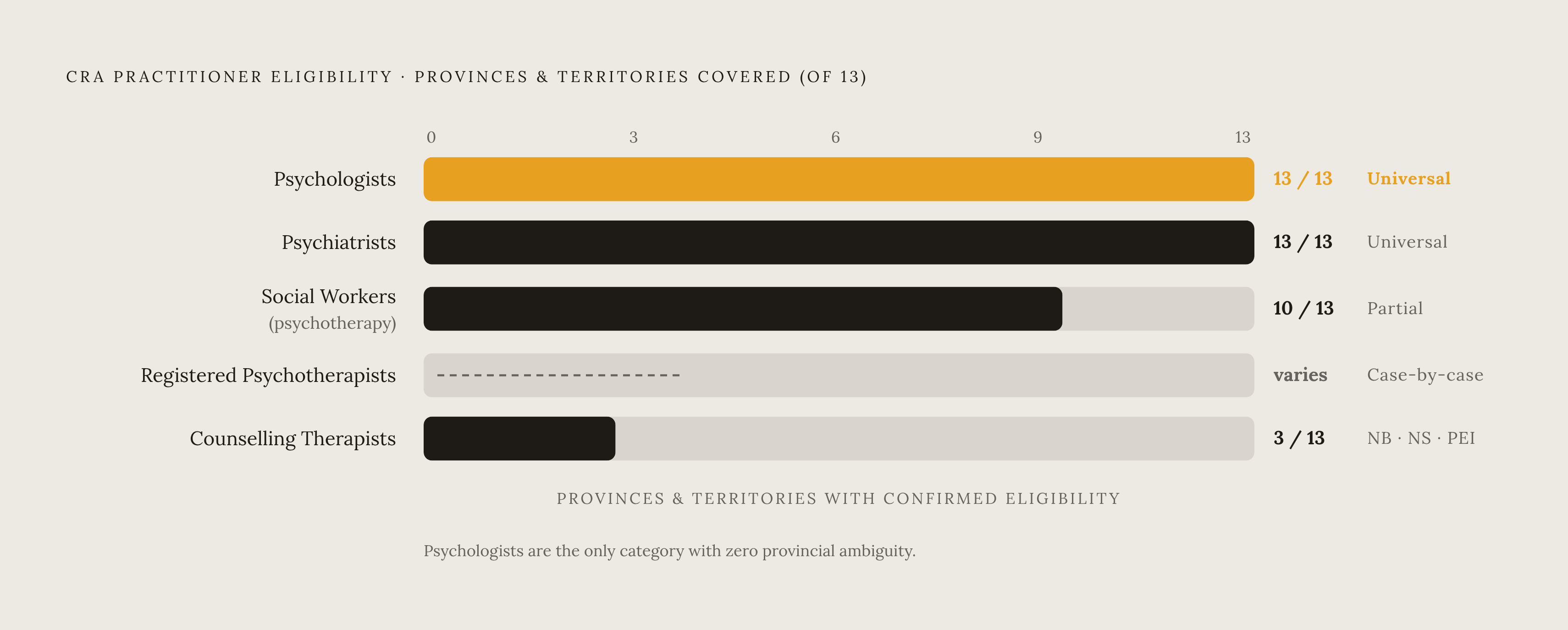
That single test explains almost every "it depends" answer in this guide. Psychologists are licensed by a provincial regulatory body in all 13 provinces and territories, which makes them the most consistently eligible category of mental health provider in the country. Psychiatrists qualify too, recognized as medical doctors under the physician category. Registered social workers providing psychotherapy are recognized by the CRA in a long list of provinces, among them Alberta, British Columbia, Manitoba, New Brunswick, Newfoundland and Labrador, Nova Scotia, Ontario, Prince Edward Island, Quebec, and Saskatchewan.
Registered psychotherapists and counselling therapists sit in trickier territory. Their eligibility changes a great deal from one province to the next: the CRA recognizes them in some provinces and not others, and separately lists counselling therapists by name in New Brunswick, Nova Scotia, and Prince Edward Island.
That provincial variation is the reason the same type of provider can be reimbursable for someone in one city and not for someone in another. Check a provider's actual regulatory status rather than assuming a professional title settles the question. Counsellors who hold only association-level designations, things like RTC, RPC, or CCC, without a provincial regulatory licence behind them, call for extra care, since CRA recognition in those cases is not automatic. Most common providers, psychologists especially, present no such ambiguity. The caution applies mainly at the edges.
Mental health services that qualify for HSA reimbursement
Once a provider clears the credential test for the province where the service happens, you can get a wide set of mental health services reimbursed.
Psychologist sessions are eligible in every province and territory, and no referral or prescription is needed from an HSA standpoint. A family doctor's referral might be required to see a psychiatrist within the public health system, but that's a feature of how the system routes patients, not a condition the HSA imposes. This category covers individual therapy sessions, psychological assessments and testing, and group therapy sessions led by a registered psychologist.
Psychotherapy qualifies when delivered by a registered psychotherapist in a province that recognizes that designation. The specific modality matters less than who delivers it: Cognitive Behavioural Therapy and other recognized approaches are eligible when the provider holds the right credential, because eligibility tracks the provider, not the technique.
Counselling therapy is eligible where the CRA recognizes counselling therapists provincially, currently New Brunswick, Nova Scotia, and Prince Edward Island, and in provinces where registered social workers providing psychotherapy hold recognized status. Marriage and family counselling from a licensed counsellor fits the same rule: it qualifies where the practitioner's provincial designation is recognized. Mental health support from registered social workers is eligible in the provinces the CRA lists for that credential.
Psychiatric care is eligible as a physician service. Getting a referral to see a psychiatrist may be a requirement of the public healthcare system, but it isn't something the HSA itself demands. Prescription medications for mental health conditions, antidepressants, anti-anxiety medications, and other drugs a licensed physician prescribes and a registered pharmacist dispenses, are eligible as well. Occupational therapy tied to mental health rehabilitation qualifies when a licensed occupational therapist provides it.
Virtual sessions follow the exact same rules as in-person visits. The employee is paying for a licensed practitioner's service, and whether that service happens over video or across a desk doesn't change what the CRA recognizes.
Less obvious mental health expenses that are also eligible
Beyond individual therapy sessions, the CRA's rules reach several mental health costs that most people never think to submit, and these are legitimate, recognized expenses rather than loopholes.
Psychological assessments for learning disabilities, ADHD, and other cognitive or psychological conditions are eligible when a registered psychologist conducts them. These assessments can run into the hundreds of dollars, which makes this one of the more financially meaningful categories on the list for families managing a child's diagnosis or an adult's late-in-life assessment.
Caretaker training is another. Reasonable costs paid to train someone, including a family member, to care for a patient with a mental infirmity qualify, as long as the patient is related to the individual, lives in that person's household or depends on them for support, and the training is paid to someone other than a spouse or common-law partner who was 18 or older when paid. This covers real situations: a family learning how to support a relative through a mental health condition, with the training costs themselves treated as an eligible medical expense.
Service animals for severe mental impairment also qualify, but you need to read the condition attached to this one carefully. For expenses incurred after 2017, the cost of acquiring an animal specially trained to help a patient with severe mental impairment can be eligible, but only if the animal is trained to perform specific tasks beyond providing emotional support. An animal that offers comfort alone doesn't meet that bar. One trained to interrupt a panic episode or perform a concrete task tied to the condition does.
All of this multiplies in value once dependent coverage enters the picture. A single HSA account covers eligible expenses not just for the account holder but for a spouse or common-law partner, children under 18, and in some cases adult children or other relatives, parents, grandparents, siblings, aunts, uncles, nieces, or nephews, who are related by blood, marriage, or law and financially dependent on the account holder. So one employee's HSA can cover a spouse's psychologist visits and a child's psychological assessment in the same year, all through a single account.
Mental health expenses that do not qualify
The CRA's rules draw a clear boundary: spending that doesn't involve a regulated health service falls outside the METC framework, whatever benefit it might offer someone's wellbeing. That boundary exists because eligibility is tied to regulated care, not to effectiveness, and understanding where it falls helps employees avoid a denied claim rather than hunt for a way around the system.
General wellness spending sits outside that boundary. Meditation apps, mindfulness subscriptions, and general stress-management programs don't qualify, because none of them are described in subsection 118.2(2) of the Income Tax Act. The same goes for self-help books, online wellness courses, and personal development programs.
Digital mental health apps split depending on what they actually deliver. An app that connects a user to virtual therapy sessions with a licensed psychologist, or telehealth consultations with a regulated practitioner, is eligible, because the employee is paying for that practitioner's service, and the app is just the delivery channel. If an app offers guided breathing exercises, mood tracking, or AI-generated advice without a regulated practitioner involved, it doesn't qualify, even if a doctor happens to recommend it informally.
Providers without provincial regulatory recognition fall outside eligibility no matter how skilled or effective they are. Life coaches, wellness coaches, and spiritual counsellors aren't licensed under provincial health legislation, so their services don't qualify. Counsellors holding only association-level designations, again, things like RTC, RPC, or CCC, without a provincial licence behind them may not qualify either, and that's worth double-checking before a claim goes in.
Emotional support animals fall on the ineligible side of the service-animal rule described above. If an animal offers comfort but isn't trained to perform a specific task tied to a severe mental impairment, it doesn't meet the CRA's criteria, no matter how much it helps.
The 2024 GST/HST exemption for psychotherapy and counselling therapy
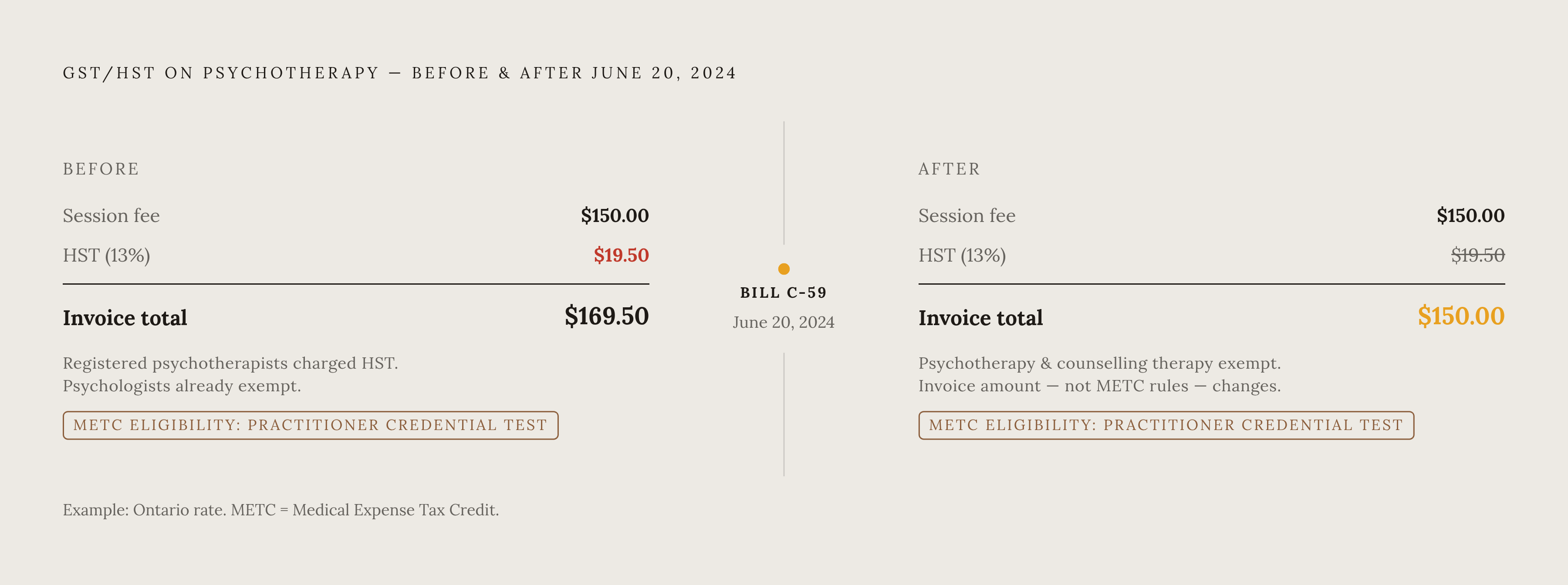
A federal policy change in 2024 lowered the actual cost of psychotherapy and counselling therapy in Canada, and it has a direct, practical effect on HSA claims. On June 20, 2024, Bill C-59 received royal assent, and that bill added psychotherapists and counselling therapists to the list of health care practitioners whose services are exempt from GST/HST when provided to individuals.
Before that date, registered psychotherapists had to charge clients sales tax on every session, but psychologists' services were already exempt. That tax was part of the invoice an HSA claim would cover, so employees were effectively reimbursing sales tax along with the cost of care. After June 20, 2024, qualifying psychotherapy and counselling therapy sessions no longer carry that tax, so the invoice an employee submits for reimbursement comes in lower than it would have before the exemption took effect.
The exemption and the METC eligibility test are two separate legal questions, and they shouldn't get mixed up. GST/HST exemption determines what shows up as tax on the invoice. METC eligibility is governed by the practitioner credential and provincial recognition rules covered earlier in this guide, and that invoice can be submitted to an HSA only if it meets that test. A service being GST/HST-exempt doesn't automatically make it METC-eligible, and a service being METC-eligible doesn't mean it was ever subject to GST/HST. The two tests run on independent tracks, and the 2024 change affects only the cost on the invoice, not the credential test that decides whether the HSA can reimburse it.
Submitting a mental health claim through an HSA
Once you settle the credential test from earlier in this guide, the documentation the CRA expects for mental health expenses is simple. A valid receipt needs to show the provider's full name and professional designation, confirming their regulated status, along with the date of service, the type of service provided (something specific, like "individual psychotherapy session" or "psychological assessment"), and the amount paid. You don't need a referral letter or physician's note to submit most mental health claims through an HSA. A receipt from a qualifying practitioner, with those four details on it, is enough on its own.
The process that follows is straightforward. The employee pays for the eligible expense out of pocket first, then collects the receipt or official invoice showing the details listed above, and submits it to the plan administrator for approval. Once approved, reimbursement arrives by direct deposit. Plan administrators also provide annual reporting, so both employer and employee get a record of what was claimed over the year, useful for tax records and for tracking how the HSA balance is used across a family's mental health care.
Sources
- Medical Expenses 2025 - Canada.ca
- Disability-Related Information 2025 - Canada.ca
- Lines 33099 and 33199
- Application of the GST/HST to Psychotherapy and Counselling Therapy Services - Canada.ca
- GST Exemption for psychotherapy and counselling therapy services Now Law - As of June 20, 2024 — Accounting Tax