Naturopathic and Alternative Medicine Eligibility in a Canadian HSA
Provincial licensing, not medical merit, determines whether alternative therapies qualify.
Naturopathic and alternative medicine eligibility in a Canadian Health Spending Account is not a simple yes or no. It comes down to a two-part test: whether the Canada Revenue Agency treats the expense as medical in the first place, and whether the practitioner delivering it is licensed in the province where care happens. That second part is the one most employees never think to check, and it's why the same acupuncture session can be reimbursed for one coworker and denied for another sitting two cubicles away.
How HSA eligibility works in Canada: the CRA-as-foundation principle
A Health Spending Account in Canada doesn't set its own rules about what counts as a medical expense. It borrows the list from the Medical Expense Tax Credit, built into the Income Tax Act. Anything that qualifies for that credit can move through a properly structured HSA and reach the employee tax-free. That's the whole foundation: no separate HSA rulebook, just the METC list, administered through a different payment mechanism.
Two conditions both have to hold before a claim gets approved. First, the type of expense has to appear on the CRA's list of eligible medical expenses. Second, whoever provided the service has to be authorized to practice under the law of the province or territory where the care happened. If either condition is missing, the claim fails, regardless of how legitimate the treatment is on medical grounds.
There's a third constraint that shapes how an employer can run the whole plan. The CRA applies what's called the "all or substantially all" test: the large majority of an HSA's reimbursements, in practice 90% or more, has to go toward expenses that qualify for the METC. That limit matters here because it means an employer can't load up an HSA with borderline alternative therapies without risking the tax-free status of the entire plan. One bad habit of over-including fringe treatments can undo the tax benefit for every other claim running through the same account.
The CRA's eligible expense list itself is wide. It covers dental work, vision care, mental health services, paramedical treatments, fertility treatments, assistive devices, and medical travel, among other categories. But it isn't open-ended. The line the CRA draws is whether an expense relates to diagnosing, treating, or preventing a medical condition, not whether it improves general health or lifestyle. An orthotic prescribed for a diagnosed foot condition clears that bar. A treatment framed as general wellness maintenance does not, even if it happens at the same clinic.
Provincial differences in treatment eligibility
The part of this system that trips people up most isn't the CRA's expense list but the practitioner licensure gate, which runs on geography rather than clinical content.
The CRA keeps a table of authorized medical practitioners broken out by province. That table is what decides whether a given practitioner type counts for HSA purposes, and it's anchored to the province where the employee actually received care, not where the employer's head office sits. An employee working remotely from Manitoba for an Ontario-based company is judged by Manitoba's rules, full stop.
This isn't a bureaucratic accident. Provinces regulate health professions to protect the public, deciding who can call themselves a naturopath or an acupuncturist and under what training standards. The CRA defers to that provincial regulatory status rather than making its own calls about which therapies are legitimate. It checks whether the province has formally licensed the person providing acupuncture or naturopathy, not whether the treatment has medical merit.
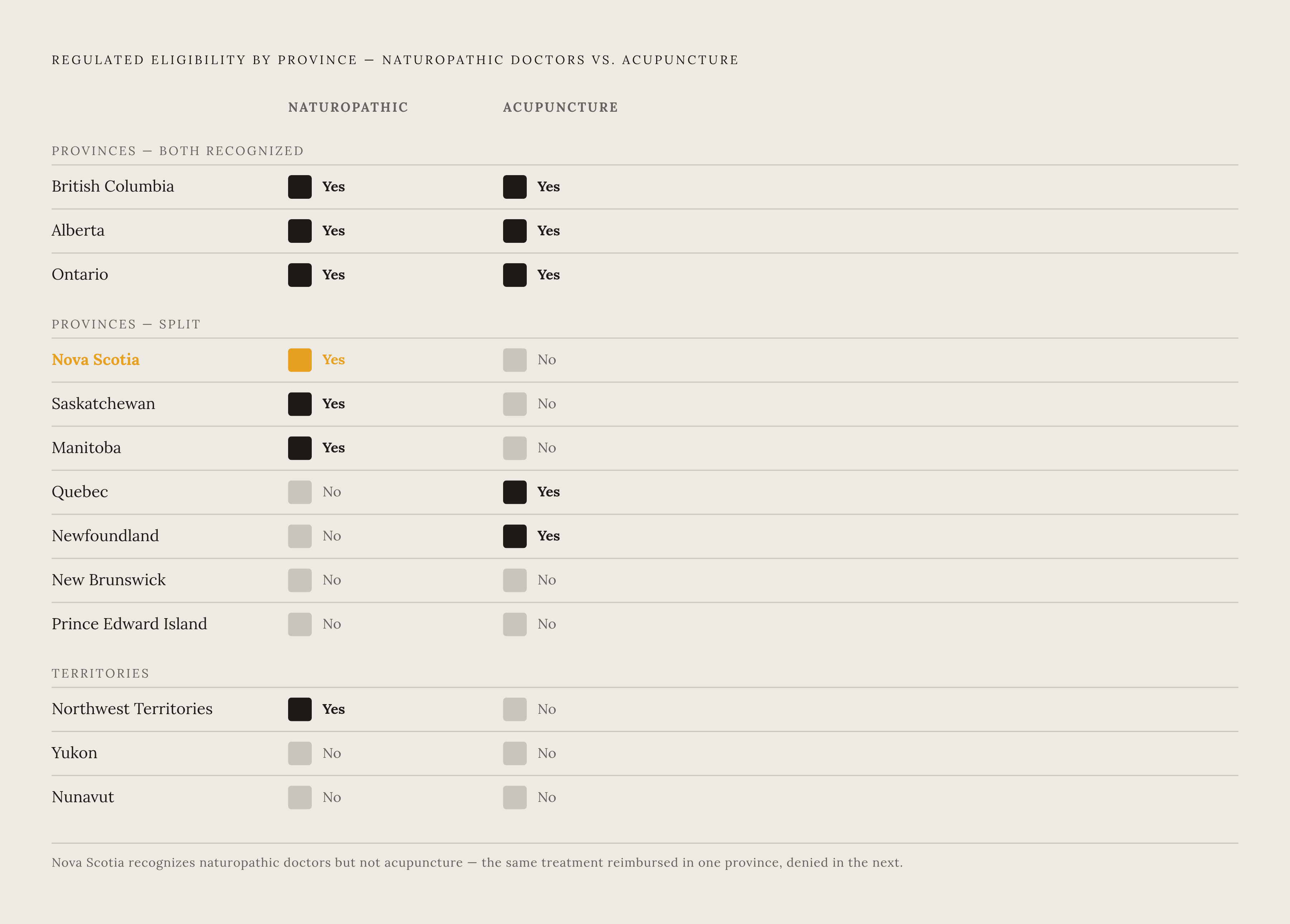
Acupuncture illustrates the effect clearly. It's a recognized, HSA-eligible practitioner type in Alberta, British Columbia, Newfoundland, Ontario, and Quebec. It is not recognized in Manitoba, New Brunswick, Nova Scotia, or any of the territories. A Manitoba employee who gets the exact same acupuncture treatment, from an equally trained practitioner, as an Ontario colleague simply cannot claim it through an HSA. The treatment is identical. The provincial licensing status is not, and that's what decides the outcome.
Naturopaths follow a similar but not identical map. They're currently recognized in Alberta, British Columbia, Manitoba, Nova Scotia, Ontario, and Saskatchewan. They are not recognized in New Brunswick, Newfoundland, Prince Edward Island, Yukon, Nunavut, or Quebec. The Northwest Territories is a partial exception: naturopaths there have been regulated since March 2022, which puts the territory in different standing than the rest of Canada's territories on this specific question. None of this is a judgment on any province's choices. It's simply the current state of provincial regulation, and it changes the eligibility map every time a legislature acts.
Nova Scotia as a case study in how regulation changes ripple into HSA eligibility
The eligibility map isn't fixed. It moves when provinces pass new legislation, and Nova Scotia shows how that happens.
When a province licenses a health profession that wasn't previously regulated, the CRA's authorized practitioners table updates to match. That update expands HSA eligibility for that practitioner type immediately, for every resident of that province, without the HSA plan itself changing in any way.
Naturopathic doctors in Nova Scotia became a regulated health profession under the province's Regulated Health Professions Act. That made Nova Scotia the seventh province or territory in Canada to license naturopathic doctors, and the first in Atlantic Canada to do so. Roughly 85 naturopathic doctors in Nova Scotia are now regulated under that Act, and the CRA's authorized practitioners table has since updated Nova Scotia to a "Yes" for naturopaths.
Counting Nova Scotia, six provinces and one territory now regulate naturopathic doctors: British Columbia, Alberta, Saskatchewan, Manitoba, Ontario, Nova Scotia, and the Northwest Territories. Naturopathic doctors practicing in the remaining provinces and territories are reportedly working toward regulation in their own jurisdictions.
The lesson for employers running an HSA across multiple provinces is straightforward: an employee's eligibility for a given treatment can change overnight, with zero changes to the plan design, purely because their home province passed new legislation. That's a reason to check the CRA's authorized practitioners table on a regular basis rather than treating an eligibility assessment as something done once and filed away.
Naturopathic service eligibility after the licensure gate
Clearing the provincial licensure gate is only the first hurdle. Even where a naturopathic doctor is fully recognized, not everything that happens in their office counts as an eligible expense. The general rule: professional services the naturopath performs are generally eligible, while products they sell are not.
Eligible professional services include consultations and appointments, saliva testing and nutritional analysis, stress management services when delivered as a professional treatment rather than a general wellness program, and prolotherapy. Injections and IV therapy sit in a more specific category: the fee to administer the treatment can be eligible, but the injectable solution or IV solution itself is not. That administration-versus-solution split is the sharpest line in the whole naturopathic category, and it trips up a lot of otherwise straightforward claims. A patient pays one combined price for an IV session, but only part of that price, the administration fee, actually qualifies.
The same rule that governs every other medical expense category applies here too: the service has to relate to diagnosing, treating, or preventing a medical condition. A naturopath appointment billed as general wellness or routine health maintenance doesn't qualify, even in a province where naturopaths are fully licensed and regulated. The practitioner's credentials get a claim through the first gate. What the visit was actually for governs the second.
The service/product split on a single receipt
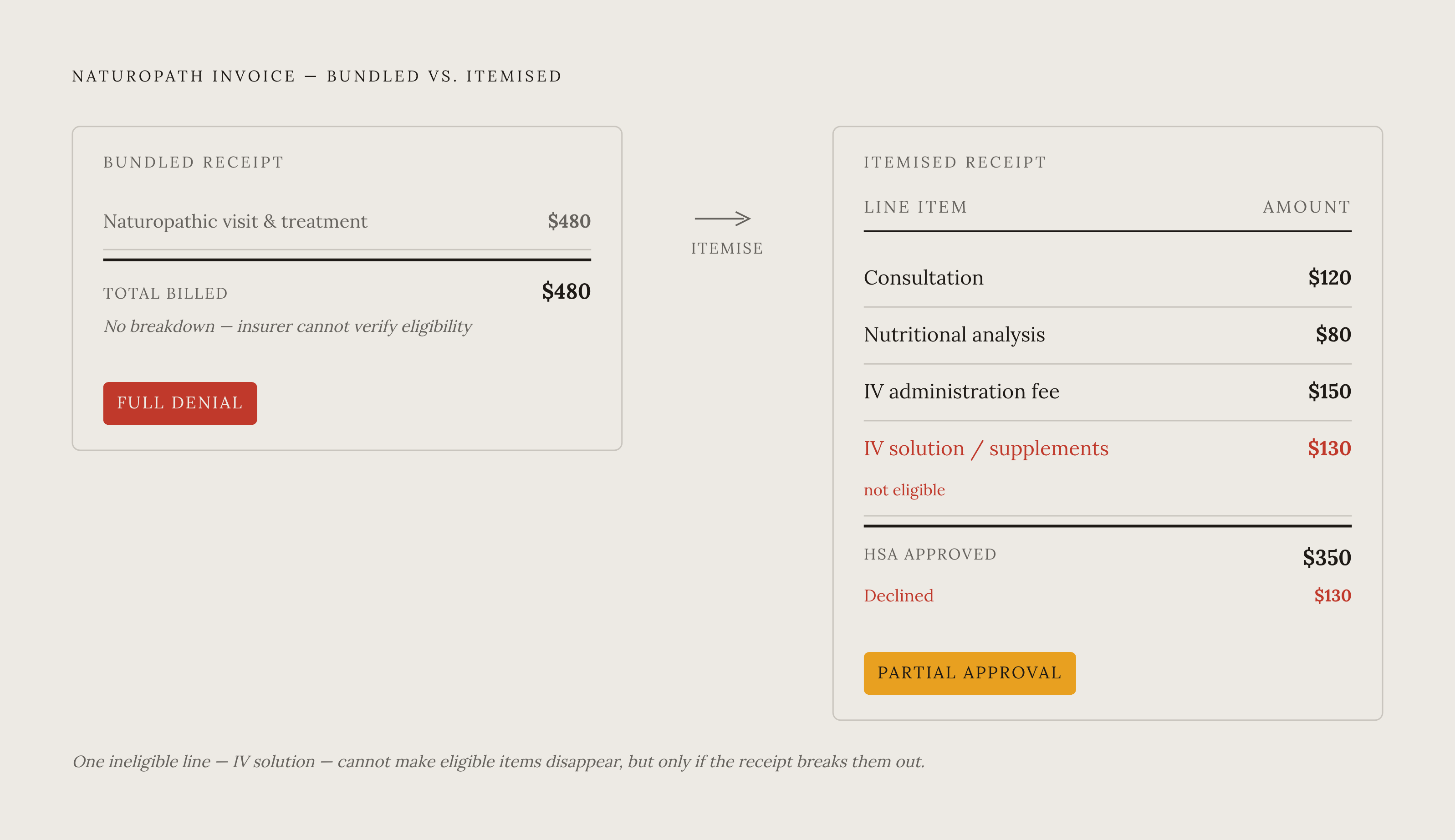
This split causes the most friction at the exact moment someone goes to submit a claim, because naturopath visits rarely produce a clean, single-purpose receipt. A typical appointment generates a receipt listing a consultation, a nutritional analysis, an IV administration fee, and the cost of the IV solution or supplements, all mixed together on one invoice. Some of those lines are eligible. Others are not. When they're lumped into a single total with no breakdown, the whole receipt can become unclaimable under a compliant HSA, because there's no way to tell which part of the payment covered what, not because the treatment was invalid.
The CRA requires documentation that proves what service was actually received, how much was paid for it, and the name and address of the practitioner who provided it. Without a line-by-line breakdown, an HSA administrator has no safe way to approve part of a receipt while declining the rest. The administrator is following documentation standards that exist precisely so the CRA can audit a claim later and confirm it was handled correctly.
A receipt that holds up under those standards needs a few specific things on it: the practitioner's name and credentials, the date the service was provided, a line-item breakdown that separates services from products, and proof that payment was actually made. When a receipt includes both eligible and ineligible items listed separately, the administrator can approve the eligible portion and decline the rest cleanly. When everything is bundled into one number, there's no way to split it, and the entire amount typically gets declined.
The fix is simple and happens at the point of care rather than afterward. Employees should ask the naturopath's office for an itemized invoice before leaving the appointment, not after submitting a bundled receipt and getting it bounced back. Getting the right paperwork at the front desk takes a minute. Going back to request a corrected invoice weeks later, after the appointment is long over, takes considerably longer and sometimes doesn't happen.
Other alternative modalities: acupuncture, homeopathy, massage, and traditional Chinese medicine
Every alternative modality runs through the same two-gate test: CRA eligibility plus provincial licensure. But the province-by-province pattern is different for each one, so eligibility for a naturopath tells an employee nothing about eligibility for an acupuncturist or a massage therapist. Each modality has to be checked on its own terms.
Acupuncture is recognized in Alberta, British Columbia, Newfoundland, Ontario, and Quebec. It is not recognized in Manitoba, New Brunswick, Nova Scotia, or any territory.
Traditional Chinese medicine practitioners are recognized in British Columbia and Ontario only, a narrower footprint than acupuncture despite the overlap between the two fields in practice.
Registered massage therapy is recognized in British Columbia, New Brunswick, Newfoundland, and Ontario. Even inside those provinces, the designation matters as much as the location: a relaxation massage delivered by spa staff without the RMT credential does not qualify, no matter how therapeutic the session was. The treatment has to come from someone holding the actual RMT designation, not simply someone working at a business that offers massage.
Services from practitioners without recognized provincial licensing, including life coaches, holistic consultants without accredited credentials, and other unverified alternative therapy providers, cannot be claimed through an HSA regardless of what the treatment involved. The content of the session isn't the deciding factor. The practitioner's regulatory status is.
The HSA-plus-WSA approach for treatments outside the CRA's eligibility map
A treatment that fails the provincial licensure test, or simply falls outside the CRA's list altogether, isn't a dead end. It can be routed to a Wellness Spending Account instead, which exists specifically for the kind of proactive health and lifestyle spending the CRA doesn't classify as a medical expense.
The tradeoff is how the money gets taxed. WSA reimbursements count as a taxable benefit to the employee, because the CRA doesn't treat them as medical expenses. The employee still gets reimbursed, but income tax applies to that portion, unlike the tax-free treatment an eligible HSA claim receives.
A growing number of employers combine both accounts into a single flex plan. The employer sets one total dollar amount per employee, and the employee decides how to split it: some going to the HSA side, which is tax-free but limited to CRA-eligible expenses, and some to the WSA side, which is taxable but covers a much broader, employer-defined range of spending. Each employee builds the split around their own health needs rather than following a one-size-fits-all policy.
Take an employee whose province doesn't recognize homeopaths under the CRA's authorized practitioners table. Under an HSA alone, that treatment gets flatly denied. Under a combined flex plan, the same visit can still get reimbursed through the WSA side, with the hard CRA boundary now a routing decision rather than an automatic rejection: does this expense go through the tax-free side or the taxable side?
Gym memberships, personal training, yoga classes, and personal development programs all belong on the WSA side, never the HSA side. The most common compliance mistake employers make is lumping non-health spending into the HSA, which puts the "all or substantially all" test, and the entire plan's tax-free status, at risk. A combined HSA-plus-WSA structure is a more complete way to cover the full range of what employees actually spend on health and wellness, with each dollar taxed correctly according to what it was actually spent on.
Provider handling of alternative medicine claims
The eligibility rules themselves don't change from one HSA provider to another. Every CRA-compliant plan runs on the same two gates and the same expense list. What does change is how clearly a provider explains those rules up front, how well it handles a messy mixed receipt, and how easy it makes the actual process of submitting and tracking a claim.
Frontier HSA is built as a pay-as-you-go Health Spending Account for Canadian small businesses, incorporated professionals, and eligible shareholder-employees. It covers the full range of CRA-eligible medical expenses described above, including paramedical services from licensed alternative practitioners where the provincial licensure gate is met. Claims go in digitally, employees can track status online without paper forms, and approved claims get reimbursed by direct deposit. There's no setup fee and no annual fee: an administration fee applies only to claims that actually get approved, so a business pays nothing for expenses its employees never submit. Annual reporting comes included, and coverage extends to employees and their dependants.
For a business that already runs a group benefits plan, an HSA like Frontier's fills in the gaps that group insurance tends to leave behind, fertility treatments, naturopathic care, and the portion of dental costs that runs past the group plan's annual maximum, among them.
Other HSA providers in the Canadian market also offer CRA-compliant plans, and the rules governing eligibility are identical across all of them. What separates one provider from another comes down to things like administration fee structure, how transparent the claim review process is, how easy the digital submission tools are to use day to day, and how clearly the provider explains eligibility rules to employees before a claim gets submitted rather than after it gets rejected. That last point matters most for alternative medicine specifically, where province-by-province variation is the single biggest source of confused employees and declined claims.
Sources
- Which naturopathic services are eligible?
- Are Naturopath Services Eligible under an HSA
- Understanding Wellness Spending Accounts in Canada
- Naturopathic doctors now a regulated profession in Nova Scotia
- Common Questions Education and Regulation - Canadian Association of Naturopathic Doctors
- Nova Scotia Officially Regulates Naturopathic Doctors Under the RHPA
- Is Acupuncture Eligible under an HSA?