Submitting HSA Claims for Expenses Paid in a Prior Plan Year
Unused credits roll forward, but prior-year expenses cannot.
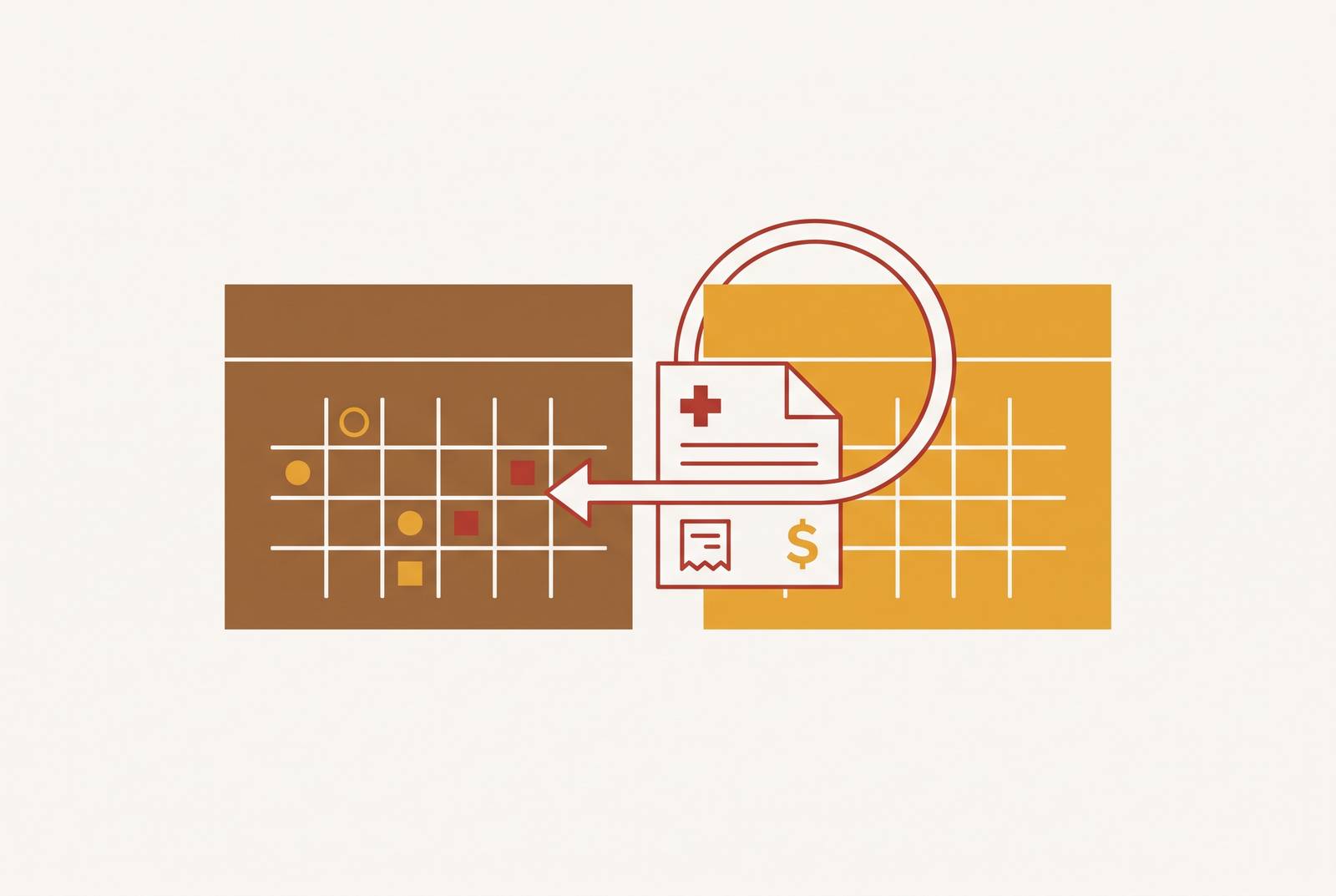
A receipt from last year and a balance still showing in your account feel like they should go together. They usually do not. The reason sits in a structural rule that governs every health spending account: unused credits can roll into a new plan year, but expenses incurred in a past plan year generally cannot be submitted against current-year credits. Knowing the difference determines whether a claim gets approved or denied.
The structural rule that makes prior-year HSA claims different from balance rollovers
Credits and expenses operate on separate, non-interchangeable clocks. An unused credit can carry into a new plan year and remain available to pay new expenses. An expense incurred in a past plan year stays tied to that year. It cannot be submitted against credits allocated for a later year.
Most employees who run into a denied prior-year claim did not break a minor procedural rule. They confused two concepts that sound similar but behave differently: balance rollover, which the plan may allow, and expense rollover, which the plan cannot allow under CRA rules. The confusion is understandable, because both involve money and time. A balance remaining at year-end and an unsubmitted receipt from the same period feel like the same problem. They are governed by entirely different rules.
DGC Benefits states the rule plainly: "You cannot carry forward an expense from one plan year to the next." The illustration is concrete. An expense incurred in October 2025 cannot be paid using money deposited in the HSA for the 2026 plan year, even if the 2025 funds are exhausted. The credits moved forward. The expense did not.
Why the date of service — not the date of payment — determines which plan year an expense belongs to
The plan year an expense belongs to is fixed by the date the service was provided. The payment date, the invoice date, and the submission date are all irrelevant to that assignment. That single fact determines whether a claim can be approved.
Consider a dental appointment in late November, an invoice that arrives in December, and a payment made in early January after new credits appear. The employee may feel that the January payment belongs to the new year's credits. It does not. The service date in November locks the expense to the prior plan year, and only prior-year credits can pay it, assuming those credits carried forward under the plan's rollover rules.
This matters most at two moments. Near the end of a plan year, a service rendered in December may not be paid or submitted until January. Near the start of a new year, an employee who has just received new credits may try to apply them to outstanding receipts from the prior period. Both moments produce the same outcome. Delaying the bill does not move the expense.
What credit carryforward actually means, and how it differs from expense carryforward
Credit carryforward means that unused employer-allocated dollars survive into the next plan year and remain available to pay expenses incurred in that next year. It does not create a second window to claim expenses from the year the credits originated. The credits move forward in time. The expenses are frozen in the year they were incurred.
DGC Benefits illustrates the carryforward horizon with a clear example. Money deposited for the 2026 plan year must be used by December 31, 2027. Carried-forward credits are consumed by current-year expenses during that extended window. They are not applied backward to prior-year expenses. A claim for an expense incurred in 2025 can be paid using credits deposited in 2024 or 2025, or both. It cannot be paid using credits deposited in 2026.
Plan design determines whether any carryforward exists at all. Some plans are strict use-it-or-lose-it with no rollover. Others allow one year of carryforward. The CRA does not mandate a minimum carryforward period, but caps any carryforward at 12 months. That is one plan year. Plans may range from strict use-it-or-lose-it to the full one-year maximum, at the administrator's discretion. The outer limit is fixed. As DGC Benefits notes, "use it or lose it" on credits is a CRA requirement. Credits cannot be carried forward for more than two years, and any unused credits not spent by the deadline are forfeited.
The submission window: how plans handle prior-year expenses that were legitimately incurred but not yet filed
Every plan provides a run-off period after the plan year closes during which expenses incurred in the just-ended year can still be submitted. This is not an exception to the rule that expenses cannot cross plan years. It is the planned window for completing submission of expenses whose service date fell in the prior year.
The distinction matters. The run-off period is about filing timing, not about which year's credits apply. The expense must still have a service date within the closed plan year. The grace period only extends the deadline for getting the paperwork in. Readers often mistake a generous submission window for permission to cross plan years. It is not.
DGC Benefits sets its deadline at June 30 of the year following the expense. That gives members roughly six months after the December 31 plan year close to submit prior-year claims, one of the more generous windows in the examples available from primary sources. The length of this window is entirely a plan design decision, not set by the CRA. The practical range across plans is wide, from a matter of weeks to several months post-year-end. Missing the deadline is final. Expenses not filed within the run-off period are forfeited, with no late-appeal process simply because the employee forgot.
How digital claim systems are tightening the practical tolerance for late prior-year submissions
Digital claim platforms timestamp submissions with precision. That precision removes the informal administrative latitude that paper-based processes once allowed for borderline or late prior-year filings. When a claim is submitted through a portal or app, the submission date is recorded automatically and matched against the plan year and run-off window. There is no room to argue that a receipt was in the mail before the deadline.
Some administrators are also setting explicit outer limits on receipt age, requiring that expense receipts not be dated more than a certain period before submission. That operates as an additional constraint on top of the plan's own run-off window. The rules have not formally changed. The enforcement environment has become less forgiving, because the system no longer depends on a person making a judgment call about when something arrived.
The practical advice that follows is simple. Submit receipts as soon as possible after the expense is incurred, rather than accumulating them for batch submission at year-end. The risk of a missed deadline or a stale receipt grows with every week of delay.
What happens to prior-year claims when employment ends mid-year
Termination compresses everything. When an employee leaves mid-year, the run-off window for prior-year and even current-year expenses typically shortens to 60 to 90 days from the termination date, rather than the standard post-year-end window. The termination date also sets a hard service-date ceiling. Expenses incurred after that date are not eligible, regardless of when they are submitted or whether credits remain in the account.
The combination of a compressed filing window and a hard service-date cutoff means departing employees face the most urgent version of the prior-year claims problem. Any unsubmitted receipts from the current or prior plan year must be filed quickly or they are lost. The stakes are highest exactly when the employee has the least attention to spare for paperwork. File everything immediately when leaving a job.
How to manage HSA timing so prior-year claims don't become a problem
The most effective way to avoid prior-year claim problems is to treat the service date as the triggering event for claim submission, not the payment date, the invoice date, or a convenient batch-filing moment at year-end. Submit each receipt shortly after the appointment or purchase, before the plan year closes and certainly before the run-off window expires. Know your plan's specific run-off deadline, because not all plans give six months. Some give only a matter of weeks. Treat that date as a hard calendar event rather than a rough guideline.
If credits from the prior year have carried forward into the current year, understand that those funds are pooled with current-year contributions into a single balance available for any qualified expense. They do not create a new opportunity to file prior-year claims. When approaching year-end, audit open receipts and outstanding expenses against the plan year's close date, not against the payment date on the bill. At termination, compile and submit all outstanding receipts before the compressed post-termination window closes. A plan with straightforward digital submission and clear balance tracking makes these habits easier to maintain. When employees can see their remaining credits and submission history in one place, the gap between expense incurred and claim submitted tends to close.
The asymmetry at the center of this rule is not a bureaucratic trap. Credits move forward in time. Expenses stay fixed to the year they were incurred. Once you build your habits around the service date, the rule stops feeling like a constraint and starts working as a predictable structure. The reader who understands that asymmetry can file with confidence and never lose a legitimate claim to a missed window.