Adjudication Process for Canadian HSA Claims
Understand the four stages of HSA claim review to improve approval rates.

HSA adjudication is a four-stage process: submission, eligibility verification, balance confirmation, and reimbursement. Understanding how each stage works helps employees submit claims correctly the first time. It also lets employers set realistic expectations for turnaround and outcomes. This guide walks through each stage in the order it happens, with a focus on where claims succeed and where they go wrong.
What HSA adjudication actually is, and why it works differently from group insurance
Adjudication in a health spending account is a compliance-verification exercise. It is not a coverage-pricing exercise, and that distinction explains most of what makes an HSA behave differently from a traditional group insurance plan. In a group plan, a claim is evaluated against a policy schedule and priced against a pooled premium. In an HSA, the funds are already employer-funded and already allocated. The adjudicator only needs to confirm two things: whether the expense qualifies under CRA rules, and whether there is enough balance in the account to cover it.
The administrator verifies CRA eligibility, confirms available HSA balance, and reviews supporting documents. The claim is then approved, partially approved, or declined. The legal foundation for all of this is the Private Health Services Plan framework under the Income Tax Act. The administrator enforces the CRA's medical expense list at the adjudication stage specifically to protect the plan's tax-favoured status.
There is no carrier float and no premium pool in an HSA. The plan operates on a pay-as-you-go basis. The employer is only invoiced after a claim clears adjudication. That means the adjudication decision directly triggers the financial transaction. One decision, three possible outcomes, and a payment that follows only if the answer is yes.
Stage one: the employee pays out of pocket and collects a qualifying receipt
Adjudication begins before the employee ever touches a portal. It starts at the point of service, when the employee pays for medical, dental, or vision care from a licensed provider. What the employee collects at that moment determines whether the claim will survive review. A qualifying receipt is the first gate in the process.
The expense must qualify under the Income Tax Act. Common examples include prescription glasses, orthodontics, physiotherapy, and prescription drugs. Where a physician's written order or prescription is required under an extended medical benefits plan, the same requirement carries through to the HSA. The same criteria apply.
Some expenses require a prescription or written certification even when the receipt itself looks complete. Drugs and medications are eligible only if they require a prescription by law and are dispensed by a registered pharmacist. Orthotics require a prescription from a licensed podiatrist or physician. The receipt alone is not enough for these categories.
The practical advice for employees is simple: obtain supporting documentation before making the purchase, not after. Missing documentation is one of the most common reasons reimbursements are denied. A provider can produce a prescription or a written order at the time of service far more easily than after the fact.
Stage two: submitting the claim through the administrator's portal
A complete submission gives the adjudicator everything needed to verify eligibility without follow-up. That is the single biggest factor in how quickly a claim moves through review. The submission should include the expense category so the adjudicator can apply the correct eligibility rule from the CRA list.
The standard flow is straightforward. The employee enters the claim through the administrator's portal, selects the expense type, attaches the receipt and any required supporting documents, and submits. A complete file at this stage means the adjudicator can move directly to verification.
Coordination of benefits adds a step for employees who also have a group health or dental plan. The employee must first submit to the primary plan and then submit the remaining balance, along with the explanation of benefits from the primary plan, to the HSA. The HSA is a payer of last resort. All other coverage should be exhausted prior to submission.
Submission deadlines vary by plan. The Manitoba Government Employees plan requires all claims incurred in 2024 to be submitted by March 31, 2025, and late claims will not be processed. Other plans may require submission within 12 months of the date of service, or within 60 days if the plan has been terminated. The deadline is plan-specific, and it is not negotiable.
Stage three: how the administrator verifies eligibility and what triggers a denial
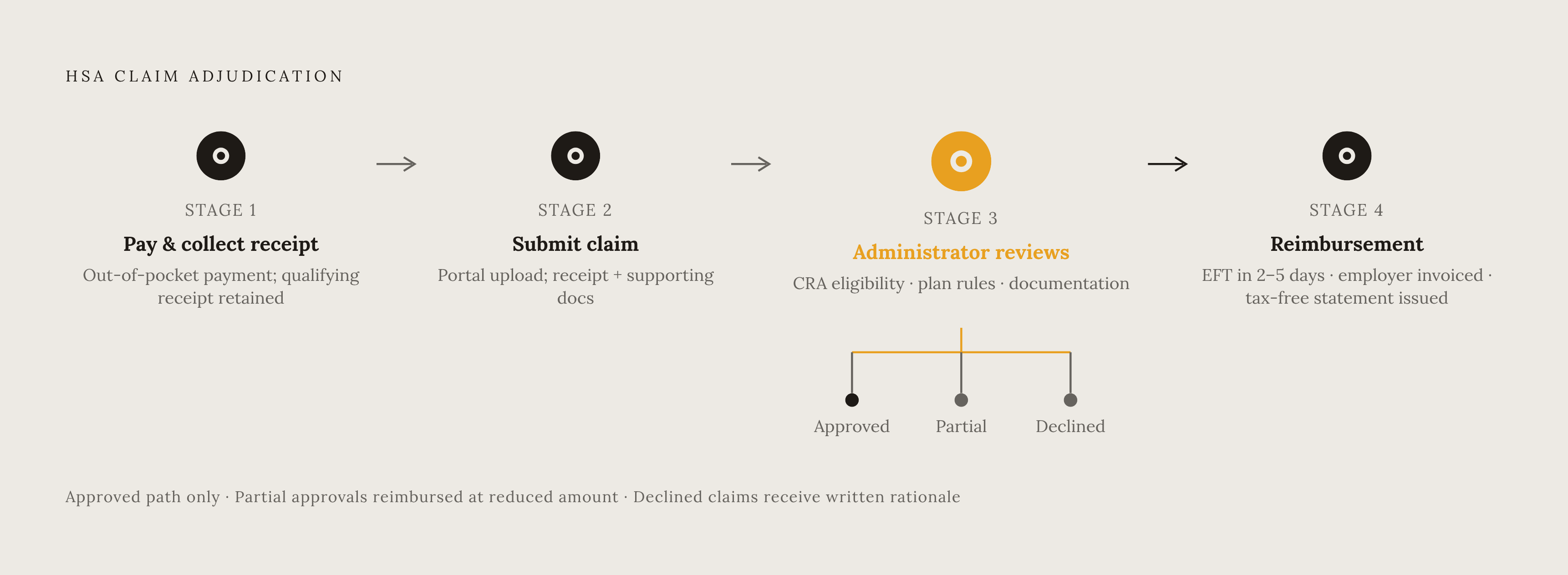
Eligibility verification is where most claim outcomes are determined. Most denials trace back to three predictable causes. The expense does not meet CRA criteria. The documentation is incomplete. Or the practitioner is not recognized in the employee's province. Each of these is knowable before submission.
The administrator checks three things in sequence. First, whether the expense meets CRA medical expense requirements. Second, whether the plan rules are satisfied. Third, whether the documentation is sufficient. The CRA's medical expense list under the Income Tax Act is the controlling standard at every step.
The "all or substantially all" test is what gives this review its teeth. Ninety percent or more of the plan's reimbursements must be for expenses eligible for the Medical Expense Tax Credit. This is what legally prevents an HSA from paying for gym memberships or general wellness spending. Ineligible items include life insurance and AD&D premiums, spa treatments, herbal remedies and supplements, and fitness classes.
Province-specific practitioner eligibility is a structural challenge in adjudication. The same receipt for the same treatment can be approved in one province and denied in another. Acupuncture is the clearest example. Whether the claim clears depends on whether CRA recognizes that practitioner type in the province where the service was performed.
Grey-zone categories create most of the disputes. Orthotics are eligible, but only when prescribed by a licensed medical practitioner authorized under CRA guidelines. The claim must include the prescription alongside the receipt. Prescription drugs follow a similar logic. The key distinction is always the documentation collected at stage one.
The outcome at this stage is one of three: approved, partially approved, or declined. A partial approval typically reflects a legitimate expense with incomplete documentation, where the adjudicator can approve part of the claim and decline the remainder. A full decline means the expense did not meet the CRA standard regardless of the paperwork.
Stage four: reimbursement, employer billing, and what the paperwork shows
Once a claim is approved, the financial transactions that follow are largely automatic. Approved claims are deposited directly into the employee's bank account by electronic funds transfer. A statement of benefits is issued, and the HSA balance is updated. The typical turnaround from submission to reimbursement is two to five business days at the adjudication stage.
The reimbursement does not appear as income on the employee's T4. This is the key tax outcome, and it is the reason the plan's PHSP compliance, enforced at stage three, matters so directly to the employee. The tax-free status depends on the adjudicator having declined every expense that would have compromised the plan.
There are two important carve-outs. Quebec employees have employer contributions reported as a provincial taxable benefit on the RL-1 slip. The federal non-taxable treatment does not apply at the provincial level. And no employee can claim an HSA-reimbursed expense for the Medical Expense Tax Credit. The expense was already paid with tax-free dollars, so it cannot be double-counted.
For the employer, the financial side is equally clean. The full invoice amount, including the claim, administration fee, and GST, is a deductible business expense. The employer pays after the claim clears, not before. The adjudication decision is what releases the payment obligation.
Why third-party adjudication is not optional for most plans
The obvious question for a small business owner is whether they can review their own claims. The answer matters because of how an HSA gets its tax treatment, not because of any explicit prohibition. CRA does not publish a rule that bars self-adjudication. But a plan where the shareholder-owner reviews their own claims may fail the "insurance in nature" test that defines a valid PHSP. The plan must constitute an undertaking to indemnify against a loss from an uncertain event, for an agreed consideration.
Using an independent third-party administrator supports arm's-length claim review. It verifies CRA-eligible expenses and maintains a clear audit trail if CRA reviews the plan. The compliance risk is not theoretical. If CRA determines a plan does not meet the criteria of a valid PHSP, reimbursements are reclassified as taxable benefits. Employees are taxed on those amounts, and the employer may face additional penalties.
For incorporated businesses where the owner is also a shareholder, the stakes are higher. The benefit must be provided in the person's capacity as an employee, not as a shareholder. If CRA determines the benefit was received because of the individual's shareholding, the reimbursement can be reclassified as a taxable shareholder benefit under subsection 15(1) of the Income Tax Act.
CRA expects records to be retained for the audit period, which is typically six years. That means every adjudication decision needs to stand up to scrutiny long after the claim is paid. An independent adjudication process is what makes that possible.
What employers should tell employees before the first claim goes in
Most claim denials and turnaround delays are preventable. Employees need to know three things before they submit their first claim: what qualifies, what a complete receipt looks like, and when the deadline is. Each of these maps directly to a stage in the process.
Eligible expenses are governed by the CRA's medical expense list, not the administrator's discretion. Employees who understand this know why a gym membership is denied and why a prescription drug is approved. The rules are external to the plan, which means they are consistent across employers and administrators.
Receipt standards matter from the point of service. The receipt should include provider name and address, date of service, nature of the service, patient name, and amount paid. Employees should check for these five items before leaving the provider's office. Where the employee has a primary group plan, the coordination order must be followed: group plan first, then the HSA for the remaining balance. Submitting to the HSA first when another plan applies is a common error that requires resubmission.
Plan-year deadlines are non-negotiable. The Manitoba Government Employees plan requires claims incurred in 2024 to be submitted by March 31, 2025. Late claims will not be processed. Employers should communicate their own plan's equivalent deadline clearly at enrollment, and employees should know the realistic turnaround expectation: two to five business days from submission to reimbursement.
The employer does not need to be the expert on the CRA's medical expense list. The administrator handles that. What the employer needs to do is set expectations before the first claim goes in. The four-stage process rewards employees who know the rules ahead of time, and the employer is the one best positioned to communicate them.