Salary vs Dividend Mix and HSA Eligibility for Shareholder-Employees
Choosing salary over dividends protects your HSA eligibility as a shareholder-employee.

An incorporated owner sitting down to decide how to pay themselves this year is usually running one calculation: how much to take as salary, how much as dividends, and which mix leaves more money after tax. That calculation has a second consequence most owners never put on the page. The same compensation split also decides whether the owner can use a Health Spending Account as an employee. The HSA runs on a specific legal structure, and the rules behind that structure care deeply about how the person claiming the benefit gets paid. Owners who understand this plan for both goals at the same time. Owners who don't may keep running their dividend strategy for years while quietly losing access to a benefit they think they still have.
How the HSA Works
A Health Spending Account lets a corporation reimburse an employee's medical expenses and deduct that reimbursement as a business expense, while the employee receives the money with no personal tax owing on it. The corporation sets an annual limit, the employee submits receipts for eligible costs, and the business pays it out. Eligible expenses follow CRA's Medical Expense Tax Credit list: dental work, prescriptions, vision care, physiotherapy, mental health services, fertility treatments, medical devices, and a long list of related costs. The appeal comes down to simple arithmetic. Paying a $2,000 dental bill out of pocket means earning well above $2,000 in personal income first, since that income gets taxed before it ever reaches the dentist. Routing the same $2,000 through an HSA skips that step, because the corporation pays it pre-tax and deducts it as a business cost. CRA sets no fixed dollar ceiling on what an employer can allocate to an HSA. The limit just has to be reasonable, which gives small business owners real room to size the plan to their own needs, assuming they qualify for it.
What CRA actually requires to recognize an HSA as an employee benefit, not a shareholder benefit
CRA's test for an HSA comes down to one question: was the benefit received by the person acting as an employee, or acting as a shareholder? That question decides everything. The PHSP definition in section 248(1) requires the plan to carry the real features of insurance, including a genuine risk assumed by the plan itself. If CRA decides the benefit went to someone in their capacity as a shareholder rather than an employee, the whole arrangement gets reclassified as a shareholder benefit under section 15(1): taxable to the person, not deductible to the corporation, which erases the tax advantage that made the HSA worth setting up.
CRA has addressed this directly, not hypothetically. Technical Interpretation 2014-0521301E5 found that a plan built around a sole employee-shareholder would likely fail to qualify as a PHSP, because it lacks the insurance elements the law requires. At the May 2022 CALU Roundtable, recorded in CRA document 2022-0928901C6, CRA went further: an HSA set up for a single shareholder-employee and their family likely does not qualify as a PHSP. CRA's reasoning was that the sole employee-shareholder is effectively paying their own family's medical bills through a company they fully own, with no actual risk sitting anywhere in the arrangement. A plan needs to look like insurance to work as insurance. A structure where one person owns the company, controls the benefit, and is the only person who can ever claim it doesn't carry that shape.
Salary Income, Dividend-Only Income, and HSA Eligibility
T4 income is the clearest proof CRA has that a person received a benefit as an employee. An owner who draws a salary creates a paper trail that supports the employee argument on every front: payroll gets set up, a T4 gets issued, CPP contributions get remitted, and the employment relationship exists in writing, not just in conversation. Those are the exact markers CRA looks for when it decides which capacity someone was acting in.
An owner who takes only dividends has none of that. No T4 exists. No payroll record exists. No formal employment relationship appears anywhere in the corporation's filings. Arguing that an HSA reimbursement was received "as an employee" becomes a hard sell when nothing in the owner's compensation history supports the claim. Dividend-only pay also lines up directly with the concern CRA raised at the 2022 CALU Roundtable: without a salary, the arrangement looks exactly like a sole shareholder funneling personal medical costs through a company they own outright, which is the specific structure CRA said likely fails the PHSP test.
What Dividend-Heavy Owners Can Do to Preserve HSA Eligibility
Taking dividends does not automatically shut an owner out of an HSA, but it does raise the bar. An owner who draws no salary and still wants to use an HSA needs a letter from their accountant confirming two things: that the person is genuinely both a shareholder and an employee of the company, and that the HSA limit being claimed is reasonable compared to what an arm's-length employee in a similar role would receive. Without a T4 to anchor that comparison, the letter has to make the reasonableness case on its own, which is a weaker position than having payroll records do the work automatically.
Some structural steps apply no matter how the owner is paid. The plan needs written text that spells out the annual limit, which expenses qualify, who is eligible, and how reimbursement works. The owner's employment contract should reference the HSA directly. The corporation should not be able to cancel or change the plan on its own, without notice, whenever it wants. None of this fully resolves the underlying concern CRA raised in 2014 and again in 2022. For a sole shareholder-employee, no amount of paperwork removes the insurance-risk gap CRA has flagged twice now. An accountant's letter and clean documentation reduce exposure. They don't eliminate it. Owners who rely entirely on dividends should treat their HSA access as a calculated risk, not a settled fact.
Sizing the Salary Floor: RRSP Room, CPP Cost, and HSA Defensibility as Simultaneous Constraints
Most incorporated owners don't land on zero salary or a full salary draw. They land somewhere in between, sized to hit several goals with one number. RRSP contribution room is usually the first input: since RRSP room comes from earned income, owners often set salary at whatever level generates the RRSP room they want for that year. That same salary figure happens to double as the reference point CRA will use to judge whether an HSA limit looks reasonable.
CPP cost pulls in the other direction. Salary triggers both the employer and employee halves of CPP, including CPP2 on earnings above the first ceiling. That's real cash leaving the business, not a paper cost, so pushing salary higher than needed for RRSP and HSA purposes is an expensive way to be generous to CPP. The HSA adds a third input to the same equation. Practitioners commonly use a benchmark of 10% to 15% of salary as a reasonable annual HSA limit, so a higher salary supports a higher defensible HSA ceiling. An owner with high medical costs, like ongoing physiotherapy or a family with significant dental needs, has a direct incentive to size their salary a bit higher just to support a larger HSA limit. The relationship runs both ways: salary size supports the HSA limit, and the HSA limit an owner wants partly determines how much salary they need to justify it.
The result, for most owners, is a blended structure: enough salary to generate RRSP room, anchor a reasonable HSA limit, and avoid an obviously dividend-only profile, with the rest of the owner's draw taken as dividends to avoid the full CPP cost of an all-salary approach. The 2026 planning environment makes this more of a moving target than a one-time decision. Changes to the federal tax bracket structure affect how much after-tax value a dollar of salary delivers at lower income levels. CPP2 adds cost for any salary floor set above the first earnings ceiling. Some provinces are weighing their own rate changes that would shift the math between salary and dividends further. None of this produces a single correct number. The salary floor is a calculation worth running every year, not something to set once and leave alone.
The documentation and plan structure that keeps an HSA defensible once the salary floor is set
Getting the salary number right solves part of the problem. The HSA plan itself still has to be built and run in a way CRA will recognize, regardless of how well the compensation mix is calibrated. Written plan text needs to cover who qualifies, how much each class of employee can claim annually, which expenses are eligible, how claims get submitted, and how dependants are handled. The owner's employment contract should name the HSA as an employment benefit, which supports the argument that the benefit flows from the job, not from share ownership. The plan can't be something the corporation can unilaterally shut down or rewrite without notice. CRA looks for that kind of permanence as one sign the arrangement carries real insurance-like features rather than functioning as a shareholder's personal expense account.
Corporations with arm's-length employees should include at least one of those employees in the plan. An HSA offered only to the shareholder-employees in a company that also has regular staff reads as far more vulnerable to the shareholder-benefit label than one that treats shareholder-employees and other staff the same way. Receipts, claims records, and reimbursement history all need to be kept on file in case CRA ever audits the plan.
Using a third-party administrator to run claims adjudication matters here because it builds an arm's-length record showing the plan is being managed consistently, not approved informally by the same person who benefits from it. Frontier HSA administers this structure for incorporated Canadian businesses: the corporation sets an annual reimbursement budget, employees submit eligible medical expenses digitally, and Frontier processes the reimbursement as a deductible business expense to the corporation and tax-free money to the employee. There's no setup fee and no annual fee. The 8% administration fee applies only when a claim gets approved, so a year with no claims costs nothing. Claims get submitted and tracked digitally, reimbursements go out by EFT, and the plan produces CRA-compliant annual reporting, which matters because contemporaneous records, not records assembled after the fact, are what an auditor expects to find. For a small business owner without an in-house benefits department, that kind of digital administration is what turns "we should document this properly" into something that actually gets documented properly, year after year.
Putting the decision together: compensation structure and HSA setup as one integrated planning exercise
Treating compensation and benefits as two separate decisions makes both of them worse. An owner's ability to defend their HSA as an employee benefit depends on the salary-dividend mix. The HSA limit an owner wants to claim partly determines how much salary they need to justify that limit. Both numbers shift every year as federal brackets, CPP2 thresholds, and provincial rates change, so this isn't a decision to make once and file away.
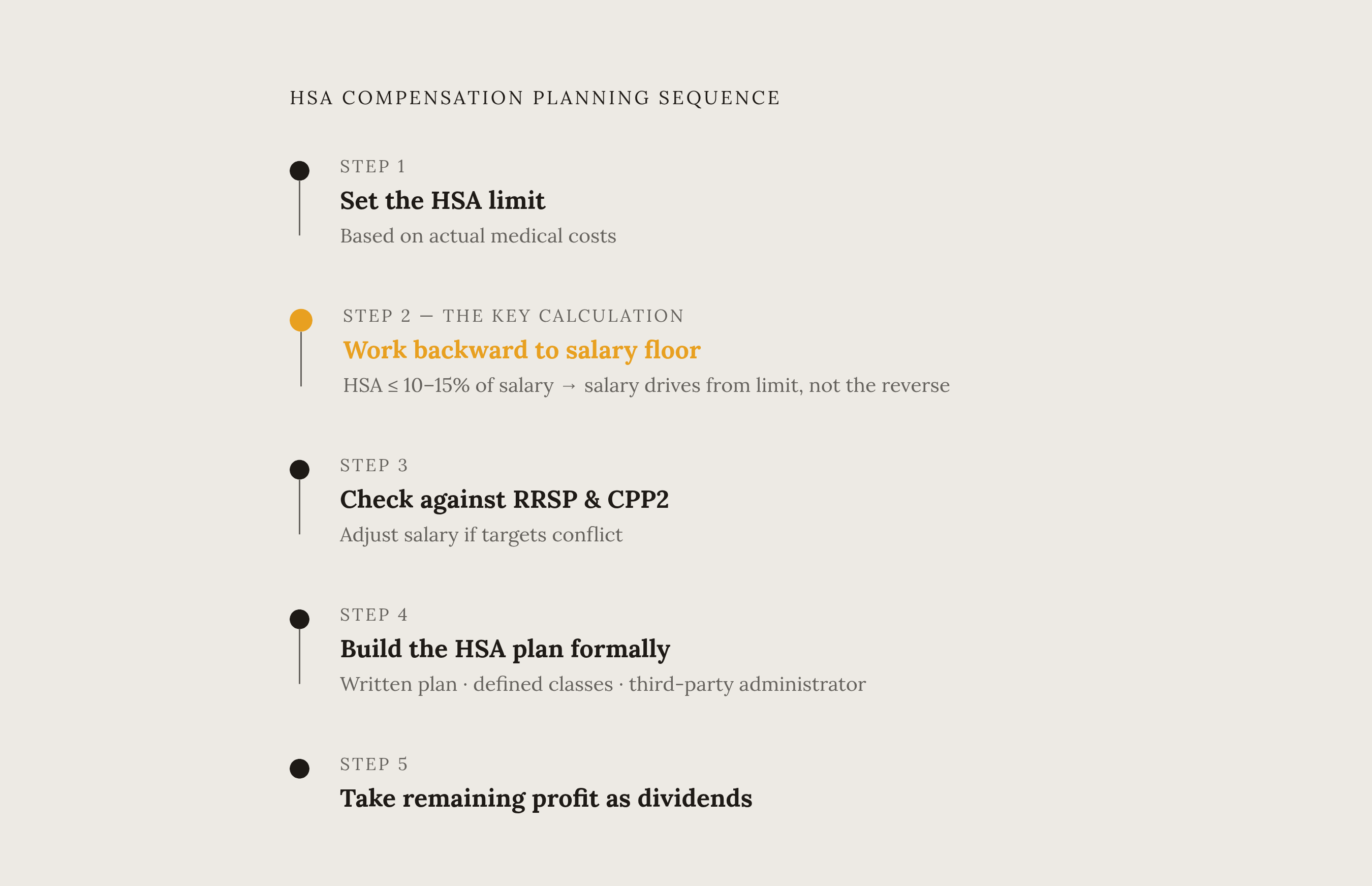
A workable planning sequence runs in order. Start by figuring out how much medical expense coverage the owner actually wants, since that sets the HSA limit worth defending. Work backward from that limit to the salary floor needed to make it look reasonable to CRA. Checking that salary figure against the RRSP contribution goal and the CPP cost it triggers may call for an adjustment if the numbers don't hold together. The HSA plan should be built formally, with written plan text, defined employee classes, and a third-party administrator keeping the records. Whatever profit is left after that gets taken as dividends. Running through those steps in order makes the salary-dividend decision and the HSA decision stop fighting each other and start supporting the same outcome.