Coordinating HSA Benefits With a Spouse's Group Plan
File claims with your group plan first, then your spouse's, then your HSA.
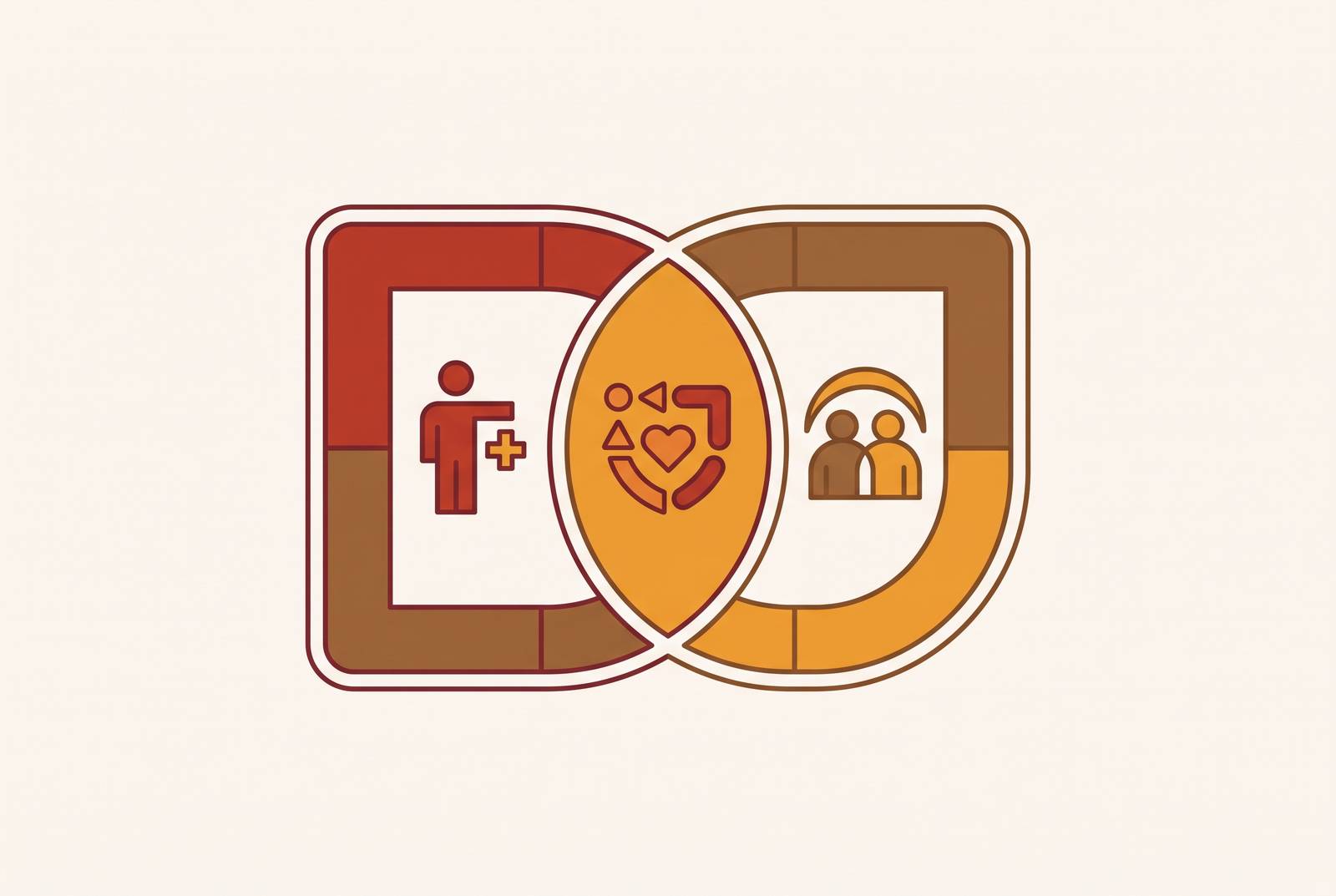
Coordinating a Health Spending Account with a spouse’s group plan is about getting claims paid in the right order. The practical rule is to use the group plans first and the HSA last, subject to your plan documents.
Why families with two benefit plans need to understand submission order before filing any claim
A family member sends a dental claim straight to the HSA and gets only part of the bill reimbursed. Later, they learn that the spouse’s group plan could have covered most of it first. The family reached for the wrong benefit before giving the other plans a chance to pay. The family has used limited credits while leaving another source of reimbursement untouched.
Two plans covering the same expense do not mean the bill is automatically paid twice, or even paid in full. One plan responds first, and the next considers what remains under its own terms. That distinction matters before the first submission. Skipping a plan can leave the household paying an expense that another plan could have covered.
The confusion grows when an employer offers an HSA instead of, or in addition to, a traditional group plan. The household may see several benefits available for the same bill and assume they are interchangeable. A group plan and an HSA occupy different positions in the payment sequence, so knowing what each spouse actually holds is the starting point.
How coordination of benefits works between two standard group plans
Coordination of benefits, or COB, sets the order in which group plans pay an eligible claim. The Public Service Health Care Plan follows the benefit coordination guidelines set by the Canadian Life and Health Insurance Association, or CLHIA. The majority of Canadian group insurers recognise those guidelines. Their purpose is to let plans work together without reimbursing more than the expense actually cost.
For your own expenses, the plan that covers you as an employee is primary and pays first. Your spouse’s group plan is secondary and considers the remaining eligible amount. The first insurer issues an Explanation of Benefits, or EOB, showing what it paid and what it left unpaid. That document must accompany the claim to the second plan. The second plan then uses its own terms to work out how much of the unpaid amount it will pay.
For dependent children, the birthday rule determines which parent’s plan pays first. The parent whose birthday falls earlier in the calendar year has the primary plan. If both parents share a birthday, the plan that has been in effect longer pays first. This rule uses the month and day of each parent’s birthday.
Separated parents have a longer sequence. With joint custody, payment starts with the earlier-birthday parent’s plan, then the other parent’s plan, then the first parent’s current spouse’s plan, and finally the other parent’s current spouse’s plan, where applicable. With sole custody, the order is the custodial parent’s plan, that parent’s current spouse’s plan, the non-custodial parent’s plan, and that parent’s current spouse’s plan. In every case, the plans together can pay no more than the expense cost.
Why an HSA sits outside CLHIA coordination rules and always pays last
A Health Spending Account, also called a Health Care Spending Account or HCSA, does not enter that same primary-and-secondary contest. The CLHIA has determined that an HCSA is outside its coordination of benefits guidelines. An employer cannot turn it into a standard secondary group plan simply by choosing to call it one. Its role is to reimburse eligible costs left after other coverage has been used.
The CRA treats an HSA as a private health services plan, or PHSP, that reimburses documented expenses. That differs from a group plan insuring against uncertain events. The HSA is typically the last payer, after applicable government programs and the employee’s and spouse’s group plans. It covers the part of a CRA-eligible expense that another plan has not already paid.
Some individual guides allow an HSA or wellness account to be used before the employee’s own core benefits, with those benefits considering the unpaid balance. Check your plan document for the order it uses, since plans can differ. That qualification does not make an HSA a group plan under CLHIA coordination rules. As a general approach, bypassing the group plans wastes the chance to use spousal coverage while also draining HSA credits.
The three-step submission order for a household with a group plan, a spouse's group plan, and an HSA
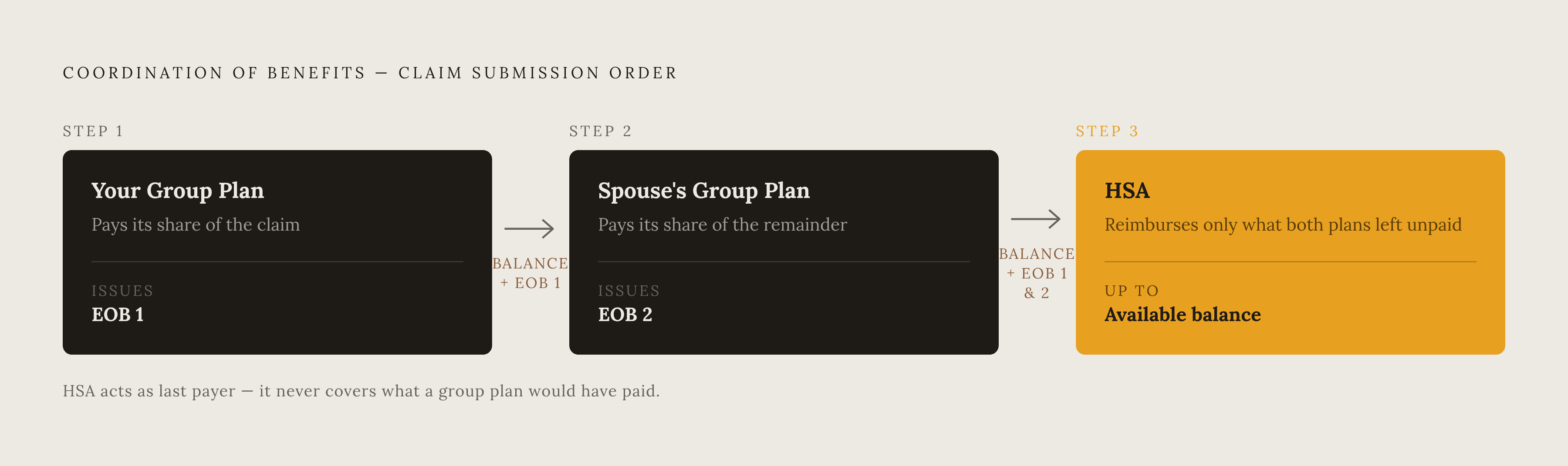
For your own claim, the first step is to submit the expense to your employer’s group plan. Consider a dental bill that the plan covers only in part. The insurer pays its share and issues an EOB showing the unpaid balance. Keep that statement, because it is the evidence the next payer needs. The first payment is not necessarily the end of the claim.
The second step is to send the remaining eligible amount to your spouse’s group plan with the first EOB. That plan uses its own coverage terms to decide how much of the balance to pay. It may cover some or all of what remains, but full reimbursement is not automatic. Obtain its EOB as well, so the record now shows what both group plans have paid.
The third step is to submit any remaining eligible balance to the HSA with both EOBs. The HSA can reimburse that balance within CRA-eligible expense categories and up to the available credit. In the dental example, only the amount left after both group plans have responded reaches the account. If the two plans cover the bill completely, there is no unpaid expense for the HSA to reimburse.
For your spouse’s own claims, the two group plans reverse positions. Your spouse’s employee plan pays first, your group plan considers the balance where family coverage applies, and the HSA remains last. The HSA portal will typically ask about other coverage. Accurate answers at enrollment and when claiming are a compliance requirement.
How submission order changes when a spouse's only plan is an HSA
If your spouse has only an HSA, there is no traditional group plan on that side of the household to act as the secondary payer. The HSA must not be entered as though it were one. Your plan administrator needs to code the coverage correctly so the claims process reflects what the household actually has. The fix starts with an accurate disclosure update.
For your own expenses, your group plan still pays first. Your HSA, if you have one, can then consider the eligible unpaid amount under its terms. Your spouse’s HSA-only coverage does not add a secondary group-plan step. For your spouse’s expenses, your group plan pays first if it has family coverage, and then your spouse’s HSA considers the eligible cost left unpaid.
The distinction changes if your spouse has both a traditional group plan and an HSA. In that case, declare the group coverage so COB can run between the two group plans as normal. If the coverage is coded incorrectly, automatic COB processing may stop and expenses may go to an HSA too soon. Correcting the coverage record helps preserve credits without changing the benefits themselves.
Why running full coordination first conserves HSA credits for expenses no group plan will touch
An HSA is a fixed annual credit set by the employer. Spending it on a bill that a group plan would have covered leaves less for expenses that genuinely need it. The cost of taking a shortcut therefore extends beyond the current claim. It reduces the account’s ability to cover a different bill later in the plan year.
A prescription drug claim may be covered only in part. Sending the balance straight to the HSA may seem quicker than submitting it to the spouse’s group plan. But if that group plan would pay the balance, the household has traded an insurance payment it could have received for credits from its own limited HSA. Full coordination avoids that exchange.
Eligible costs may include laser eye surgery, fertility treatments, the cost of orthodontics beyond plan maximums, or care from licensed alternative practitioners. For example, if neither group plan covers an eligible laser eye surgery expense, a conserved HSA can pay it entirely if enough credit remains. Eligibility and the available balance still govern the payment.
Many employers pair a core group plan with an HSA for precisely this reason. Using each group plan first gives the HSA a distinct job.
What dual-coverage households need to disclose and keep on file
Coordination works only when the plans have accurate information about other coverage. At enrollment, each spouse must tell their own plan administrator about the other spouse’s benefits. That disclosure needs to distinguish a traditional group plan from HSA-only coverage. When a new job, a plan redesign or a change in family status alters the arrangement, update both administrators. Missing information can create claim problems and payments that have to be reversed.
The paperwork is straightforward once it becomes part of the claim routine. Photograph receipts and save every EOB. Each EOB forms a link in the documentary chain, showing the next payer what has already been reimbursed. Without that record, the secondary plan and HSA administrator cannot confirm that prior coverage has been exhausted. Keeping the documents together makes the final submission easier to support.
Answer questions about other health or dental coverage with the right details, even when the account feels separate from the household’s insurance. The HSA’s tax-free treatment depends on it operating as a legitimate private health services plan. Accurate reporting helps keep the payment tied to a documented expense that has not already been reimbursed.
Quebec employees also need to account for a tax difference. Employer contributions to an HSA are a taxable benefit on the Quebec provincial return, reported in RL-1 Box J, even though they are not federal taxable income. That tax difference changes how much each HSA dollar is worth after tax. It belongs in the household’s assessment of the benefit.
The Canadian Dental Care Plan creates a hard boundary for dual-coverage households
Health Canada says that to qualify for the Canadian Dental Care Plan, a household must have no access to private dental insurance or coverage. The definition includes traditional insurance plans and health and wellness accounts. An HSA that covers dental expenses can therefore affect eligibility even if it has never been used. If either spouse holds that coverage, the entire household may be disqualified from the CDCP.
This is not another layer to add after the private plans. Coordination between a private plan and the CDCP cannot occur. Providers must not send CDCP claims for patients who have private dental coverage. The key distinction is access to coverage, rather than whether a household has chosen to claim against it.
For lower-income households, this rule means weighing the value of having an HSA. The value depends on the size of the HSA credit, typical household dental expenses and provincial income. An unused account should not be mistaken for having no coverage. Consult the plan administrator and a tax or benefits professional before making a household-specific decision about the trade-off.
For coverage you already have, check both plan documents, give the right details about the benefits and keep the EOB from each step. Understanding the layered submission order turns two benefit plans and an HSA into coverage whose value builds across the household’s expenses.