Canadian HSA Provider Comparison on Fees and Plan Structure
Fee structures can swing your annual HSA costs by thousands depending on claim volume.

Every provider of that kind of health spending account in Canada plays by the same CRA rulebook. Nobody argues about that. What actually separates one provider from another is fee structure, and that difference can swing a small business's annual cost by hundreds or even thousands of dollars depending on how many claims get filed and how big those claims run.
All of them administer Private Health Services Plans under the Income Tax Act. Reimbursements are generally deductible for the business and land tax-free in the employee's pocket, no matter which provider processes the claim. The list of eligible expenses doesn't change either: dental work, vision care, prescriptions, paramedical services like physio or massage, all covered under the same CRA definitions regardless of who's running the plan. Provincial income tax applies to employer HSA credits in Quebec, which trims the tax advantage without erasing it.
So if the tax treatment and the eligible expenses are identical across the board, why does the provider choice matter? Because the fee model sitting on top of that framework determines how much of the money actually reaches employees versus how much gets eaten by admin costs. Get the pricing structure wrong for your claim pattern, and it's possible to pay two or three times more than necessary for the exact same coverage.
How employers typically size annual HSA budgets
Budget sizing tends to fall into a few rough bands, and where a business lands says a lot about which fee model will serve it best.
Small employers and solo professionals often start lean, somewhere between $300 and $800 per year. That's enough to cover dental cleanings, a pair of glasses, and the occasional physio visit, but it won't stretch much further.
Mid-market employers tend to be between $800 and $1,800. At that level, prescriptions start entering the picture regularly, along with specialist fees and mental health services like counseling or psychotherapy, which have gotten more expensive to access out of pocket over the past several years.
Executive-tier plans or businesses with high-need employees often run $2,000 to $5,000 per year, sometimes tiered by seniority or role. A senior employee managing a chronic condition or a family with ongoing orthodontic costs can burn through a $5,000 allowance without much trouble.
These numbers matter for everything that follows. A solo consultant setting aside $2,500 a year faces a completely different cost equation than a ten-person team pushing $30,000 through the plan annually. Fee structures that look cheap at low volume can turn expensive at scale, and the reverse holds just as often.
The three pricing models HSA providers use
Three pricing structures dominate the Canadian HSA market, and understanding the mechanics of each one is the actual work of choosing a provider.
Cost-plus, or pay-per-use, charges a percentage on every approved claim. No annual subscription, no fixed charge sitting in the background. Cost tracks usage directly: file more claims, pay more; file fewer, pay less. The percentage fee across the industry typically runs 5% to 10% per claim.
Fixed or annual fee models charge a flat subscription no matter how many claims come through. Low-volume users overpay relative to what they'd spend under a percentage model, but once claim volume crosses a certain break-even point, the flat fee becomes the cheaper option by a wide margin.
Hybrid models blend the two: a small fixed amount per claim plus a percentage on top. Whether that ends up predictable or not depends on two variables at once, how many claims get filed and how large each one is, which makes hybrid pricing harder to estimate in advance than the other two models.
Fee model is only half the picture, though. Funding mechanics operate on a separate axis entirely, and they change the cash-flow experience even when the fee itself stays constant.
Pre-funded plans require the employer to deposit money upfront. Reimbursements move faster once that float exists, but the cash sits parked and unavailable for anything else in the meantime.
Pay-as-you-go structures draw funds only when a claim gets approved. That's easier on cash flow, though some providers still require manual invoicing on the back end, which adds a step someone has to remember to do.
Pre-authorized debit, or PAD, automatically withdraws the claim amount, the fee, and any applicable tax the moment a claim clears. No manual invoicing, no pre-funded float sitting idle. It's the closest thing to a "set it and forget it" arrangement among the three.
Fee model and funding model are independent choices. A provider can run cost-plus pricing with PAD funding, or a fixed annual fee with a pre-funded structure. The percentage a provider advertises on its homepage is one input among several in the whole cost story.
Provider-by-provider breakdown: fees and structure
Pricing details below reflect publicly listed terms reviewed between February and August 2026. Fee structures change, so confirming current terms directly with a provider before enrolling is worth the five minutes it takes.
Kibono runs a cost-plus model: $0 per year in subscription cost, with an 8% admin fee charged on approved claims. No setup fee, no per-employee charge, and cancellation is available at any time according to its advertised terms. Reimbursement moves fast, within 24 hours by EFT once a claim clears. The plan structure targets incorporated small businesses and solo professionals across Canada, and the pure percentage-based pricing means there's no fixed cost sitting on the books when claim activity is light.
That kind of structure tends to favor exactly the kind of lean, unpredictable claim pattern a solo professional or a two-person shop deals with. When claims might total $400 one year and $1,800 the next, paying only for what gets used avoids paying a flat annual fee regardless of whether it gets earned back.
What the cost scenarios show across claim volumes
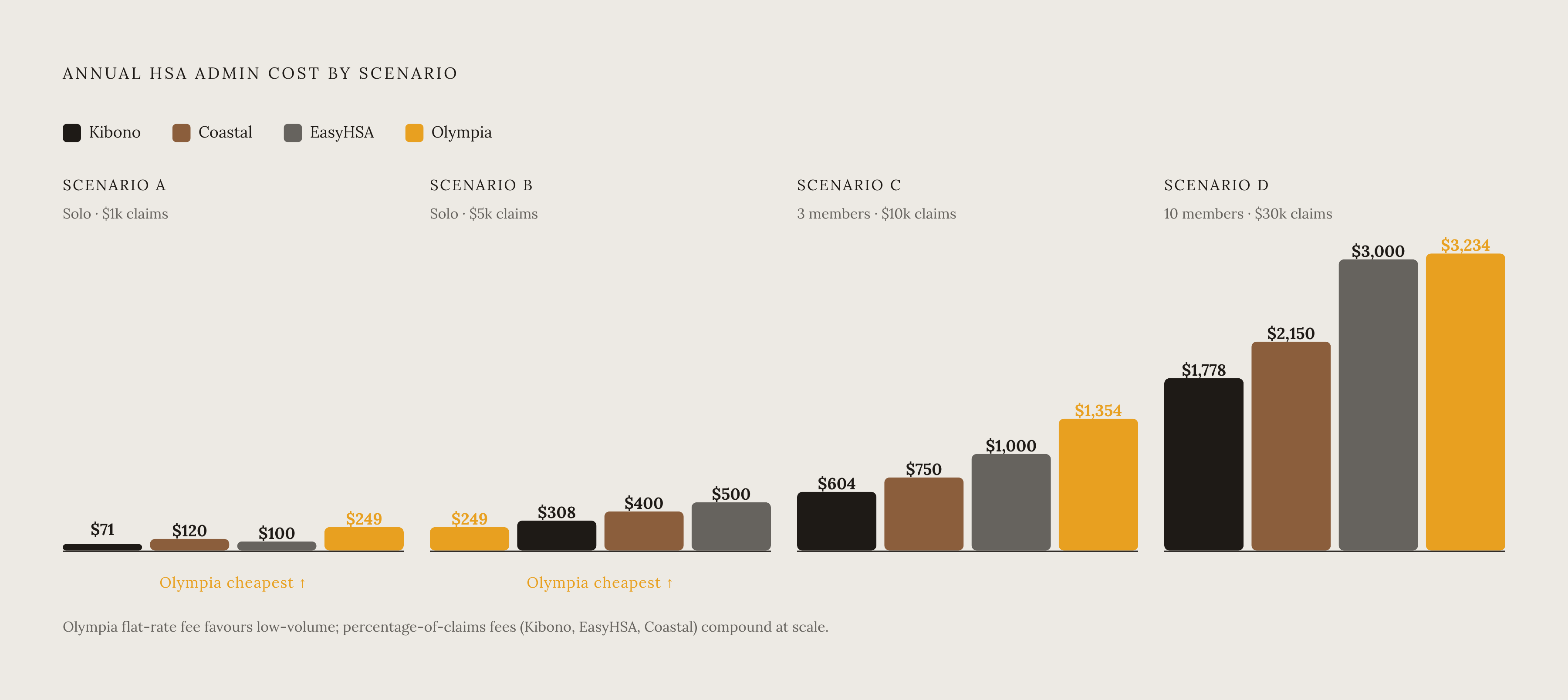
Numbers make this concrete faster than any description of pricing philosophy can. Four scenarios, each scaling up claim volume and team size, show how the different fee structures actually perform against each other in dollar terms.
Scenario A: solo owner, $1,000 in annual claims across 8 claims. Kibono is $70.50. EasyHSA and Wellbytes (pay-as-you-use) each are $100.00. Coastal HSA runs $120.00, which folds in a one-time $50 setup charge. Olympia Benefits' Basic plan is $249.00, the highest of the group at this volume.
Scenario B: solo owner, $5,000 in annual claims across 20 claims. The order flips for most providers. Olympia Benefits' flat structure now wins at $249.00, since the annual fee doesn't move regardless of volume. Kibono follows at $307.50. Coastal HSA is $400.00, while Wellbytes and EasyHSA both are $500.00.
Scenario C: a team of three, $10,000 in annual claims across 35 claims. Kibono holds the lowest cost at $603.75. Coastal HSA runs $750.00. EasyHSA and Wellbytes both are $1,000.00. Olympia Benefits comes in highest in year one at $1,354.00, a figure that includes setup costs and per-employee fees layered on top of the base plan.
Scenario D: a team of ten, $30,000 in annual claims across 90 claims. Kibono again posts the lowest total at $1,777.50. Coastal HSA follows at $2,150.00. EasyHSA and Wellbytes both are $3,000.00. Olympia Benefits is $3,234.00 for year one, again reflecting the added setup and per-employee costs baked into that first-year figure.
Lining those four scenarios up makes the pattern hard to miss. Percentage-based pricing scales with claim value, so it stays cheap when claims are modest and climbs as claim size grows, but it never front-loads a fixed cost that has to get earned back first. Flat annual fees work in the opposite direction: they punish low-volume years and reward high-volume ones, which is why Olympia's Basic plan wins outright in Scenario B but trails badly in Scenario A.
None of the five providers here comes out ahead in every scenario. That's not a flaw in any single pricing model, it's the direct result of fee structure interacting with claim volume in predictable, calculable ways. A business that knows its typical claim pattern, low and irregular versus steady and high-volume, can run these same numbers against its own projected spend and land on the structure that actually fits, rather than guessing based on which provider's marketing page sounds the most polished.