Low-Fee HSA Providers in Canada Ranked by Real Claims Experience
Employers must evaluate HSA administrators on actual claims handling, not just advertised fees.

The best Canadian health spending account is the one that combines clear total costs, accurate claim reviews and reliable reimbursement for the employees using it. To compare providers, employers need to look at how real claims are handled, whether the business qualifies and how much medical risk they are willing to fund.
Why a low admin fee percentage is a misleading headline figure
The most prominent number in an HSA advertisement can be the least informative one. An employer may pay a percentage of claims, but setup charges, annual per-employee fees and per-claim minimums can change the bill. Small or infrequent claims feel those charges most. A lower advertised percentage can therefore produce a higher total cost than a simpler plan with a higher percentage.
Employees still need someone to check their expenses correctly and pay them back reliably, and employers need to know what they are paying for. Choosing by percentage alone is like choosing a bank by its advertised rate without checking the monthly maintenance fee. The useful question is not just “What is the fee?” but “What do employees and the business get for it, and when?”
How a Canadian HSA claim actually moves from receipt to reimbursement
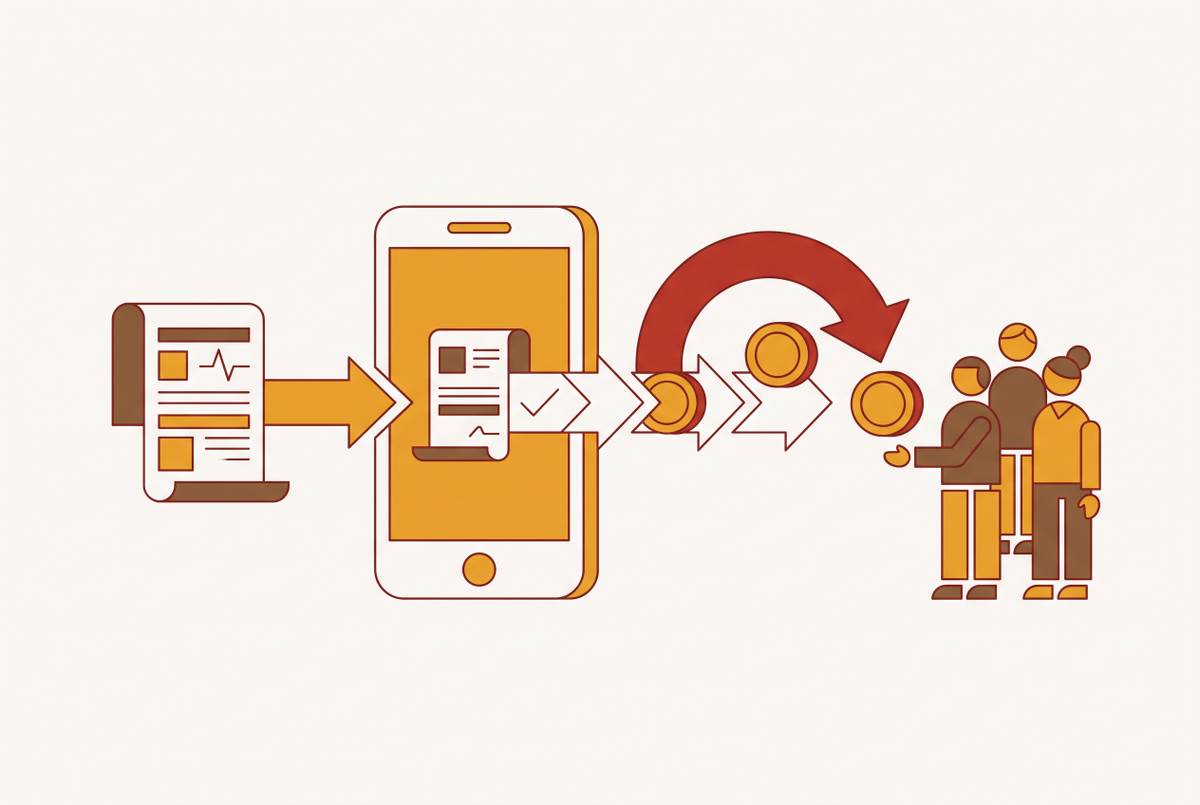
For a Canadian HSA claim, the employee first pays out of pocket. The employee keeps a receipt showing the date, provider name, service type and amount, then submits it digitally to the administrator. The administrator reviews the expense against the plan’s eligibility rules and the employee’s available allowance. Approval is the point where the administrator decides whether the expense belongs in the plan.
Once approved, the claim moves to reimbursement by electronic funds transfer, or EFT. Under a model that invoices after approval, the employer receives a bill for the claim amount plus the administration fee. Other arrangements require the employer to deposit funds in advance. That changes the employer’s cash flow, even when both plans charge a percentage-based fee.
For employees, the important interval runs from submitting the receipt to receiving the money. A fast review is useful, but it is not the same as a completed reimbursement. The provider needs to say which of those stages its promised time covers so the employer knows what to expect. Otherwise, “fast claims” leaves the actual wait unexplained.
The tax treatment depends on the arrangement qualifying as a Private Health Services Plan, or PHSP, under the Income Tax Act. A product name does not establish that qualification. For an incorporated employer with a qualifying arrangement, both the claim reimbursement and administration fee are deductible business expenses. That makes correct administration part of the plan’s value.
Why the tax structure makes fee and reimbursement reliability more consequential than they look
A qualifying PHSP allows deductible employer contributions and employee reimbursements that are not added to income federally. Under that treatment, approved health claims have no effect on the employee’s federal T4. Quebec has an important exception. Employer contributions are treated as a taxable benefit provincially even when they are not taxable income federally, so “tax-free” needs that qualification.
The “all or substantially all” test applies across the plan and generally requires the substantial majority of benefits paid to relate to CRA-eligible medical expenses. An administrator that approves ineligible expenses can put that test at risk. Ease of approval is not the goal. Consistent application of the eligibility rules is.
The eligible range is broad, including dental care, prescription drugs, vision care, mental health practitioners and paramedical services such as physiotherapy, chiropractic, massage and acupuncture. It also includes medical devices, hospital services, lab and diagnostics, ambulance services, fertility treatments including IVF, and certain over-the-counter items when prescribed. Breadth does not mean unrestricted spending, however. The HSA must leave out cosmetic procedures without medical purpose, gym memberships, vitamins without a prescription and over-the-counter drugs without a prescription, though a separate taxable wellness account can cover them.
CRA strongly recommends that a qualified third party run the plan, and self-administered arrangements carry a greater risk of breaking the rules if they fail to meet the insurance-in-nature requirements. That makes review accuracy a tax safeguard. For an incorporated owner who is also an employee-claimant, a mistake can affect both the business and personal tax position. A provider that asks a necessary eligibility question may be doing a better job than one that approves everything quickly.
Who can actually use a Canadian HSA and which business structures change the rules
Incorporated business owners who receive T4 employment income from their corporation can participate as employee-claimants. Their plan still needs to be structured and documented as a compliant PHSP. Incorporation alone is not the whole test. The employment relationship and the way benefits are provided also shape whether the arrangement works as intended.
Shareholder-employees need to work in the business on an ongoing basis, have an employment contract and take part in the plan on terms consistent with the benefits offered to others in the same employee class. For owners paid only through dividends, it is less clear whether they qualify because CRA expects T4 employment income for access to an HSA. A common accountant recommendation is to include at least a modest salary in the compensation mix. That is a compensation decision.
Very small incorporated businesses also need to establish which benefit limits apply to owners and related family members. The presence of arm’s-length employees can change the rules. Those limits affect how much the plan can pay, which in turn affects whether fixed fees are worth the cost. Comparing fees before eligibility and allowances are settled can therefore give a false picture of what claims will cost.
Sole proprietors face a different starting point. CRA has stated that an arrangement for a sole proprietor without arm’s-length employees does not qualify as a PHSP, so amounts paid into it are generally not deductible. Unincorporated employers with arm’s-length employees may qualify under different conditions. For a small business setting up an HSA, the first decisions are therefore business eligibility, employment eligibility and a compliant plan structure, followed by the allowance and administrator.
Which Canadian HSA fee structure costs least at real claim volumes?
No single fee structure is cheapest at every claim volume. Three common forms are a pure percentage of claims, a percentage plus an annual per-employee charge, and a percentage plus a flat charge for each claim. Each responds differently to usage. Annual claim dollars alone do not settle the comparison because employee count and claim frequency can also affect the bill.
With a pure percentage model that has no setup or annual charges, the administration cost depends directly on how much is claimed. When there are no claims, there is no administration charge under that structure. This suits variable or uncertain usage because the employer does not pay a fixed fee while waiting to learn how much employees will claim. Its trade-off is straightforward, since the fee grows as reimbursed spending grows.
A percentage model with an annual per-employee fee adds a cost no matter how much each employee claims. That fixed amount adds more to the cost of a plan when employees claim little or nothing. With consistent, higher-dollar usage, it becomes a smaller share of total spending. Even with heavy use, whether the plan costs less overall still depends on the percentage charged and all the other fees.
Small, frequent claims attract the flat charge repeatedly, while larger, less frequent claims absorb it more easily. Claim count becomes a separate cost driver. Teams that submit prescription refills or other lower-cost expenses may therefore pay different fees from teams that spend the same amount over the year through fewer claims.
To compare these structures, employers need to apply the full fee schedule to their likely annual spending, team size and number of claims. Funding terms belong in the same comparison because prefunding commits cash before claims are processed, while invoicing after approval follows a different cash-flow pattern. Promises about reimbursement times also need to say whether the clock starts at receipt or approval. Naming a provider as the lowest-cost or easiest for claims would go beyond what the facts show without published fees that can be compared and evidence of how well claims are handled.
What to evaluate beyond the fee when comparing HSA providers
The practical checklist starts with eligible-expense breadth and review accuracy. Does the administrator apply the broad CRA range, or does the plan use a narrower internal list? A narrower list can exclude expenses employees reasonably expected their health benefit to cover. Yet permissive approval is no better if it admits ineligible spending. The standard is accurate, consistent review within the documented plan, with clear answers about what is covered.
Digital access is the next test. Employees should be able to submit receipts from a phone, track claim status and see their remaining allowance without making a call. Those are basic functions. They let an employee distinguish a submitted claim from an approved one and understand how much allowance remains available.
Employers also need to ask about reimbursement because being able to upload a receipt easily does not show how easy it will be to get paid. EFT direct deposit is the standard for speed and reliability, while paper cheques add time and reconciliation work. The timeline should say when the clock starts and when the money should arrive. A provider that publishes no timeline offers no firm basis for comparing that part of the service, and a published promise alone does not prove consistent performance.
Annual reports should show which claims were paid, how much of the balances was used and the total deductible amounts for accounting and CRA documentation. The fee schedule should also make clear which charges apply beyond the percentage. A pay-as-you-go label is not enough. The employer needs to know whether it means fees only on approved claims, no fixed charges, or something less complete.
Dependant coverage and support complete the comparison. The plan should cover the employee’s spouse or common-law partner and household dependants as contemplated by CRA’s PHSP rules, rather than restricting a broader permitted benefit to the employee alone. Support should explain eligibility clearly and promptly, especially for owners who are not benefits specialists.
When an HSA alone is enough and when pairing it with traditional coverage makes more sense
An HSA can be a useful primary benefit for a small incorporated business with modest, predictable health expenses. The employer sets an allowance, while employees choose which eligible expenses to prioritize within it. There are no medical questionnaires or waiting periods for pre-existing conditions. With a claims-only fee structure, the employer also pays no premiums for benefits employees never use.
That flexibility has a hard limit, however. An HSA does not pool risk in the way traditional insurance does. If a family member incurs very large medical costs, the corporation funds eligible claims up to the plan limit rather than spreading those costs across an insurance pool. A larger allowance increases available reimbursement, but it does not change that underlying structure.
A common solution is a core group plan covering categories such as prescription drugs and major dental, paired with an HSA for the employee’s out-of-pocket share and gaps in the core coverage. The two arrangements serve different purposes. Traditional coverage provides pooled protection subject to its terms, while the HSA adds spending flexibility. This can make more sense for a team whose potential claims exceed what the employer is comfortable funding directly.
For a one- or two-person incorporated business where the owner is healthy and expenses are modest and predictable, a standalone HSA with a well-chosen annual limit is often the most cost-efficient structure. The choice depends on risk tolerance and the likely claims profile. A low fee earns its place only when the benefit works for the people submitting the receipts.